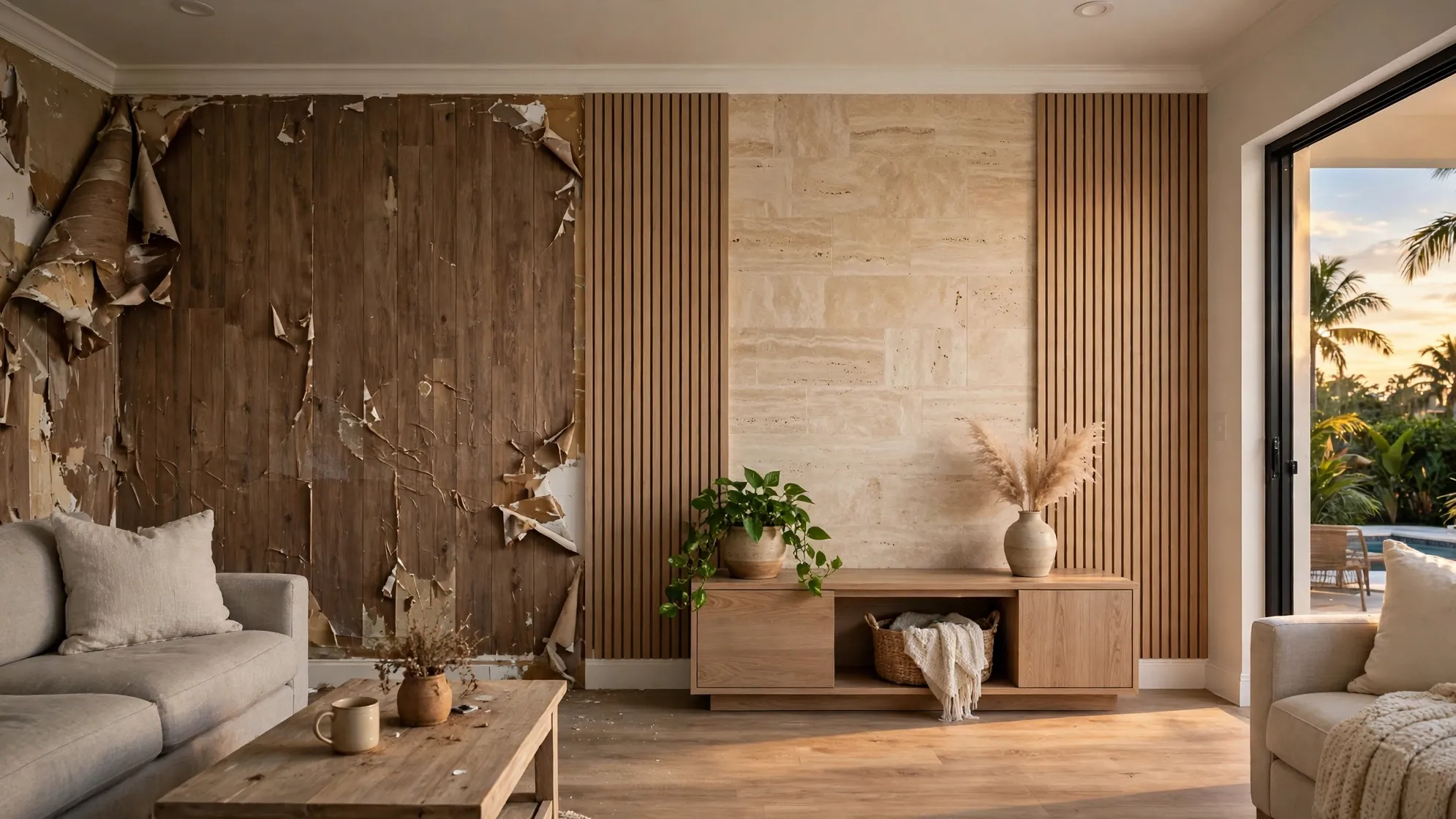
Short answer (WallPanels Studio data): Peel-and-stick panels last about 3–5 years in gentle conditions — less in Florida humidity, where edges lift as the adhesive softens and lets go. They grip only smooth, clean, fully cured painted walls; on texture, stucco or fresh paint they fail early or tear paint off on removal. They are the right tool for renters, kids' rooms that change fast, and testing a look. Professionally installed panels are a different product: real materials (stone, wood, textile, metal) fixed with adhesive and mechanical fastening on a prepared base, seams sealed, lighting integrated — a wall built to stay for many years, in humid rooms included. Our published studio tiers: stock design from $850; fitted to your wall usually $2,200–$2,700; full custom turnkey from $9,999. Not sure which side your wall belongs on? Send a photo through our wall form for a free AI preview and an honest recommendation.
The question people actually type: "are peel and stick wall panels worth it"
It is one of the biggest retail searches in this whole niche — "peel and stick wall panels", "are peel and stick wall panels worth it". The promise is seductive: no tools, no mess, a new wall in an afternoon, and it peels off when you are done. Some of that promise is real. The honest answer depends on three things the product pages do not print in large type: your wall, your humidity, and how long you expect the result to last.
What peel-and-stick actually is
A peel-and-stick panel is a thin decorative skin — printed vinyl, foam or a thin composite — with pressure-sensitive adhesive already on the back. You remove the backing sheet and press it on. That is the whole system: the glue layer is the structure. Everything good and everything bad about the format follows from that single fact.
The good is real:
- Speed. One accent wall in an afternoon, no drying time, no installer.
- Reversibility. On a properly prepared wall it lifts off later — which is why renters love it, fairly.
- Low entry cost. You pay for material only.
Where peel-and-stick fails — and Florida speeds it up
- Heat and humidity soften adhesive. South Florida homes cycle between air conditioning and warm humid air for most of the year. Reviewers and installers report the same pattern: edges and corners lift first, then whole sheets let go — typically inside 3–5 years in mild rooms, sooner in steamy or sun-heated ones.
- It needs a perfect wall. Smooth, clean, and painted with fully cured paint. On orange-peel texture, stucco or brick it never truly grips — and the texture telegraphs through thin skins, so the wall looks cheap even while it holds.
- It bonds to the paint, not the wall. On fresh or low-quality paint, removal can take flakes of paint with it. The "damage-free" promise quietly assumes a sound, cured paint film.
- It is a picture of a material. Printed wood grain and printed stone read as print up close, in raking light, and to the touch. On a small, low-traffic wall that may be fine. As the main wall of a living room, most owners tire of it.
- Wet zones are out. Behind a shower or in constant steam, adhesive systems are the wrong tool — see our guide to waterproof shower wall panels.
What "professionally installed" actually changes
A professional panel wall is not the same product with a labour charge added. Four things change:
- The base is prepared, not hoped for. The wall is checked for moisture, level and soundness first — the same "dry and sound before anything goes on" rule we use in every room, from laundry rooms to bathrooms.
- Fixing is adhesive plus mechanical. Panels are bonded and pinned into profiles or battens, so gravity and humidity never negotiate with a glue film alone.
- Seams and edges are sealed and finished. No lifting corners, because there is no exposed adhesive edge to start from.
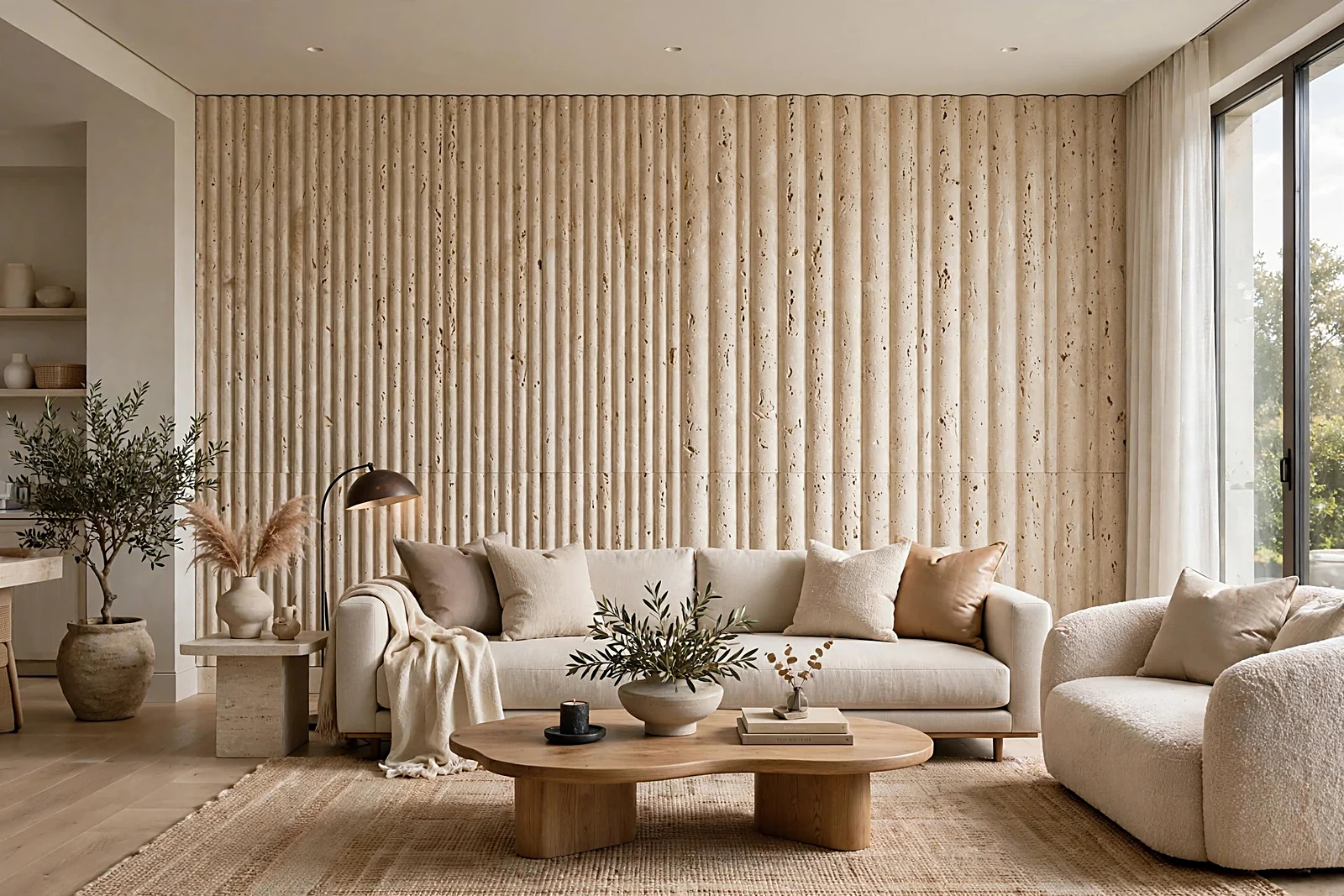
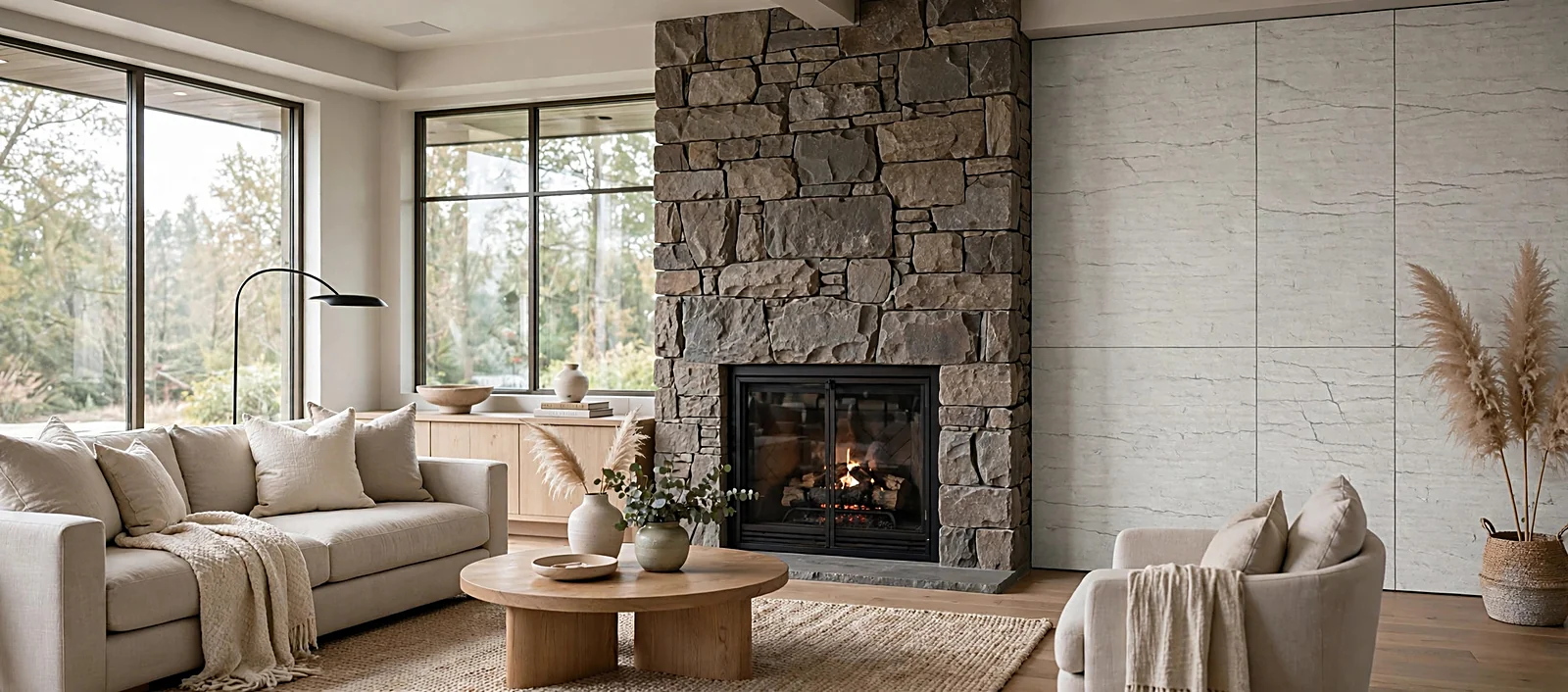
- The material is the material. Real travertine faces, real wood slats, woven textile, brushed metal — with depth, weight and shadow that print cannot imitate. Today's dining-room reel shows the build step by step: travertine TRA-04 in the centre, slats SLT-04 framing it; the entryway reel pairs cliff stone CLF-01 with brushed metal MET-05. Full range in our catalog.
And the wall is designed, not just covered: panel mixes are composed for the room, hidden LED profiles are built in, and TV wiring, consoles and doors are planned into the layout — the difference between a covering and a media wall.
The honest split: which one is yours?
Peel-and-stick is a fair choice when:
- You rent, and the wall must go back to plain.
- The room changes fast — a nursery or kids' room on a two-year cycle.
- The wall is small, smooth, dry and low-traffic, and you are testing a look before committing.
Professional installation is the right spend when:
- You own the home and the wall is a main wall — living room, entry, dining, the wall behind the bed.
- The room is humid, sun-heated, or the wall takes daily hits (chairs, bags, kids, dogs).
- You want the result to still look deliberate in ten years — and to read as architecture, not decoration, when the home is photographed for sale. On resale value, see are wall panels worth it.
The cost trap in the middle
The expensive outcome is neither product — it is peel-and-stick bought as if it were permanent: a full living-room wall of premium self-adhesive kits, replaced twice in six years, plus repainting after the second removal. Priced honestly over a decade, the "cheap" wall often costs more than the fitted one. Our published studio tiers keep the comparison simple: stock design from $850; fitted to your wall usually $2,200–$2,700; full custom turnkey from $9,999 — and the fitted wall is the one still on the wall when the decade ends.
TL;DR (WallPanels Studio data)
- Peel-and-stick = adhesive is the structure: fast, reversible, renter-friendly; ~3–5 years, less in Florida humidity; smooth cured walls only.
- Professional = prepared base, adhesive plus mechanical fixing, sealed seams, real materials: built to stay, humidity included.
- Renting or testing a look → peel-and-stick, honestly chosen.
- Owning, main wall, humid or high-traffic → professional, once.
- See your own wall first: send a photo through our wall form — free AI preview, and we will tell you plainly which side of this split your wall belongs on.
AI-generated concept illustration — for visualization, not a photo of real work.