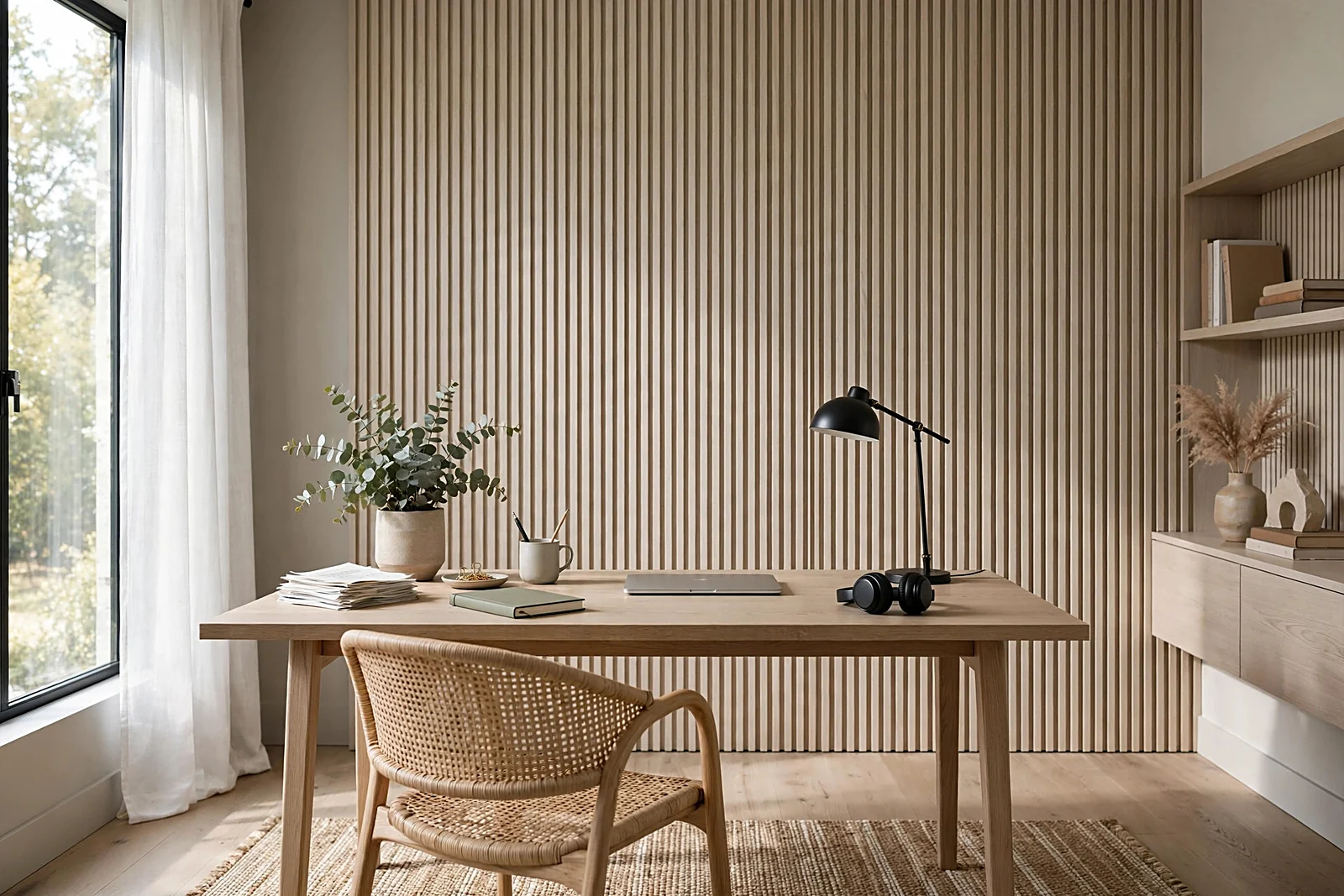
The short version, by WallPanels Studio: DIY saves you the labor bill - roughly 10-30% of the total job - and wins on simple, flat walls. It LOSES on slat walls with precision cuts, TV walls with wiring, uneven walls, and wet rooms: one crooked first panel, one wall of wasted material, or one moisture mistake can cost more than hiring a pro from the start. Rule of thumb: if the wall needs more than a saw, a level, and adhesive - get a quote first. Text a photo of your wall to SMS / WhatsApp +1 754 306 0666 and we will tell you honestly whether it is a DIY wall or a pro wall, before you spend a dollar.
What does a pro actually cost?
Short answer: Labor usually adds $0.25-$3 per sq ft depending on complexity - most public sources put it at 10-30% of the total job. You are buying speed, tools, and someone accountable if a seam opens.
Public numbers, not our price list (our install pricing is quoted per wall - text us a photo):
- Decorative panel installers add $0.25-$3 per sq ft of labor on top of materials, depending on how complex the pattern is - and labor "will not account for more than 10 to 15 percent of the total cost" in most cases (CoowinWPC, wall paneling price guide). A general contractor hired by the hour runs about $90/hr on top of the panels themselves.
- For acoustic slat panels specifically, pro labor runs 15-30% of the panel cost, or roughly $75-$150/hour depending on the market; a single home-office wall is a two-to-three-hour job (Homeia, acoustic panel installation guide).
- One manufacturer baseline for 2026 puts fully installed acoustic wood slat panels at $12.50-$25/sq ft and WPC/PVC panels at $9-$19/sq ft, materials plus labor (George Panel, 2026 cost guide).
What that labor buys: a wall done in 1-2 days (see our installation timeline guide), clean cuts around outlets, and no second weekend spent fixing your own work. For the full picture of what an accent wall costs in South Florida, see our installation cost breakdown.
What does DIY actually cost?
Short answer: Less money, more of everything else - tools, a weekend, 5-10% extra material for waste, and all of the risk. One public estimate says DIY saves $100-$300 in labor on a standard-sized room (CoowinWPC).
The real DIY budget has four lines, not one:
- Materials - the same panels a pro would buy.
- Tools - saw, level, adhesive gun, caulk, shims. If you own none of this, your first wall is your most expensive one. Peel-and-stick panels skip most of this; slat panels do not.
- Time - a pro does an accent wall in a day or two. Your first wall takes a weekend, minimum, plus three tutorial videos per step.
- Waste - budget 5-10% extra material for miscuts and offcuts (standard industry allowance, GTO FRP 2025 estimates). On premium slat panels, one miscut panel is real money.
Plus the line nobody budgets: rework. A wall you tear down and redo costs you twice - materials plus a second weekend.
5 walls DIY handles just fine
Short answer: Flat panels, peel-and-stick, lap joints, pre-cut kits, and any single straight wall in a dry room. If it needs just a saw, a level, and adhesive - DIY it.
Public guides agree on the easy list (CoowinWPC): sticky-bead panels, flat panels, pre-cut raised panels, lap-joint panels. Our take for real homes:
- Peel-and-stick panels - the training-wheels wall. Rent-friendly, reversible, forgiving.
- Flat PVC panels in a dry room - few cuts, straight lines, wipe-clean finish.
- A single straight bedroom or hallway wall - no corners, no outlet every two feet.
- Pre-cut panel kits - the factory did the measuring for you.
- Lap-joint / shiplap-style panels - the joints hide small sins.
Even here: dry-fit everything before you glue, keep the room temperature stable, and trim slowly with a sharp blade (MagicDecor, mural installation guide - the advice transfers perfectly to panels).
5 walls where DIY backfires
Short answer: Slat walls with precision cuts, TV walls with wiring, uneven or damaged walls, wet rooms, and anything above a comfortable ladder height. This is where "I saved $300" becomes "I lost $1,000."
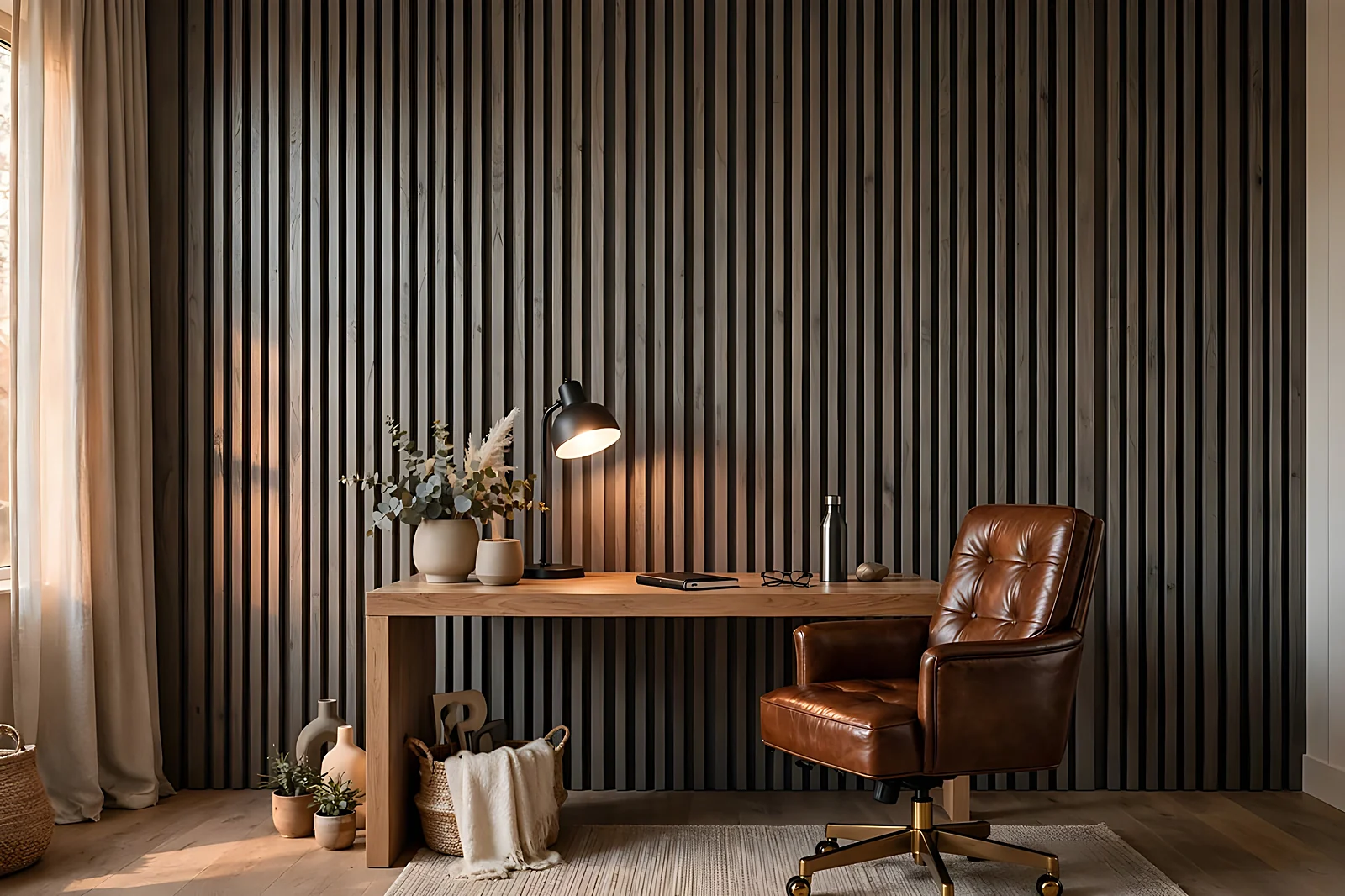
- Acoustic slat walls. Every slat must be level and evenly spaced, or the whole wall looks drunk. Cutting around outlets in felt-backed slats is a skill, not a guess.
- TV walls with wiring. Power, HDMI, soundbar cables - a pro routes them invisibly; a DIY wall ends up with cables exiting sideways or, worse, a screw through a wire.
- Uneven or damaged walls. Panels follow the wall underneath. If the wall waves, the panels wave. Pros shim and level first; most DIY guides skip this step entirely.
- Wet rooms. Bathroom or laundry walls need the right material (PVC/WPC only - MDF swells and never recovers) plus sealed edges. Get the material wrong and the wall is a write-off within months. See our materials vs Florida humidity guide.
- Tall walls and ceilings. Gravity, scaffolding, and panels that weigh more than you expect. The safety math changes above ladder height.
The 6 mistakes that make DIY MORE expensive than a pro
Short answer: A crooked first panel, skipped acclimation, the wrong adhesive, no expansion gaps, bad wall prep, and sloppy cuts around outlets. Each one has a price tag.
- The first panel is not plumb. Everything after it drifts. By panel six you are an inch off, and the only fix is starting over (DIYDoer, DIY vs pro wallpaper guide - the same geometry as panels).
- Skipping acclimation. Panels must sit in the room 24-48 hours with the AC running before install, with expansion gaps left at the edges. Skip this in Florida and the wall moves after you finish - open seams, bowed panels.
- The wrong adhesive. Construction adhesive in a rental takes the drywall paper with it on removal - and the repair usually exceeds the cost of proper clips (Homeia). Match the adhesive to the panel and the wall, or use mechanical fixings.
- No expansion gaps. Wood and WPC move with heat. No gaps means buckling on a sun-blasted wall or in a garage.
- Dirty or glossy walls. Dust, gloss paint, or old adhesive residue ruins the bond. Panels peel weeks later, and you find out when one falls off. Clean, prime, then stick.
- Outlets and switches. One wrong cut wastes a whole panel, and premium slats are not cheap. Pros template every outlet; DIYers eyeball it.
Any ONE of these on a premium material erases the entire labor saving. Two of them, and DIY cost you more than the pro quote.
How to hire right (if you go pro)
Short answer: Ask how they handle outlets, expansion gaps, and single-panel replacement. Their answers tell you everything about who you are hiring.
Three questions, five minutes, zero jargon:
- "How do you handle outlets and switches - and can I see a photo of one you did?" Precision around outlets is the visible difference between a pro and someone with a saw.
- "What expansion gaps do you leave, and do you acclimate the panels first?" If they look confused, keep looking. In Florida this is not optional.
- "If one panel gets damaged later, how does it get replaced?" A cracked panel usually means swapping the whole piece - ask how, and whether the new panel will match the batch color.
And the honesty test: a good installer will talk you OUT of the wrong material for your room. If someone happily quotes MDF slats for your bathroom, that is your answer - find someone else. Our materials guide tells you which material belongs where.
DIY or pro? The 60-second decision tree
Short answer: Simple flat wall, dry room, you own the tools - DIY. Slats, TV wiring, wet rooms, uneven walls, tall walls - get a pro quote first.
- Peel-and-stick or flat panels, one straight wall, dry room → DIY. Text us a photo anyway - we will confirm the material choice free.
- Slat wall, stone-look, or concrete-look panels → pro quote first. The precision cost of a mistake exceeds the labor saving.
- TV wall with cables to hide → pro. Invisible wiring is a craft.
- Bathroom, kitchen, laundry → pro, and only PVC/WPC. Material selection is the whole game here.
- Wall is uneven, cracked, or was never straight → pro. Prep is 80% of the result.
- You are renting → DIY peel-and-stick, or ask us about removable options. Do not glue anything you cannot remove.
Still unsure? That is exactly what the free consultation is for. Text a photo of your wall to SMS / WhatsApp +1 754 306 0666, tell us the room, and we will tell you in one message: DIY wall or pro wall - and show you how it looks with panels in a free AI preview. Serving Broward County, Fort Lauderdale, Boca Raton, and Deerfield Beach.

Sources
- CoowinWPC - How Much Does It Cost to Install Interior Wall Paneling? - https://www.coowinwpc.com/pvc-wall-panels-and-wood-wall-paneling-price/
- Homeia - How to Install Acoustic Wall Panels: DIY vs. Professional. - https://homeia.com/home-improvement/how-to-install-acoustic-wall-panels-diy-vs-hiring-a-professional/
- DIYDoer - DIY or Professional? Wallpaper Installation: The Costly Mistakes No One Talks About. - https://www.diydoer.com/blog/diy-vs-pro-wallpaper-installation-the-costly-mistakes-no-one-talks-about
- MagicDecor - Most Common Mistakes to Avoid With Wall Mural Installation. - https://magicdecor.com/blog/most-common-mistakes-to-avoid-with-wall-mural-installation/
- George Panel - How Much Does the Wall Panel Cost in 2026? - https://www.georgepanel.com/how-much-does-the-wall-panel-cost/
- GTO FRP - FRP Panels Installation Cost: Contractor vs DIY (2025 Estimates). - https://www.gtofrp.com/FRP-Panels-Installation-Cost-Contractor-vs-DIY-2025-Estimates-id45396885.html
---