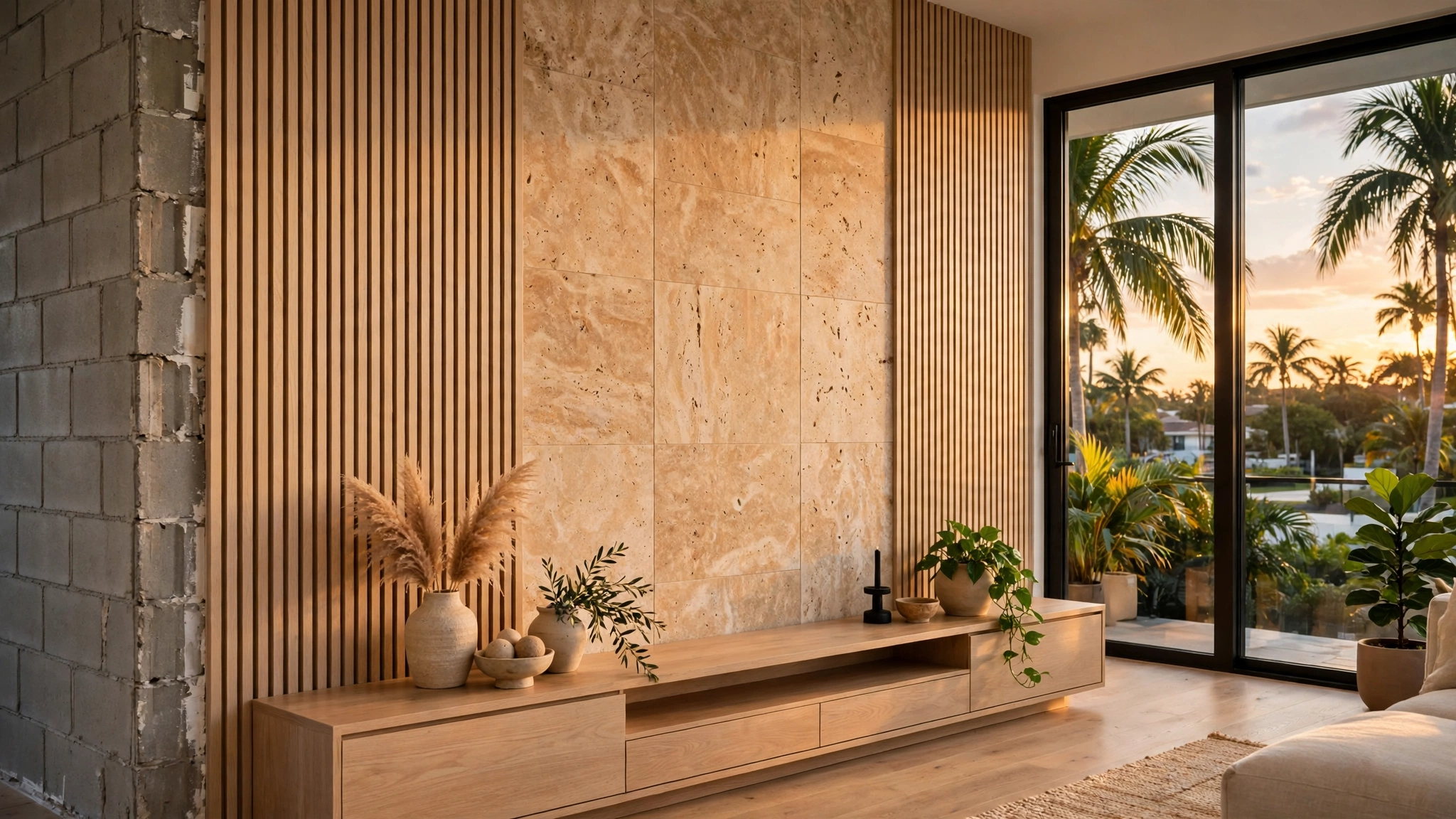
Short answer (WallPanels Studio data): Yes — wall panels install well on interior concrete block (CBS) walls, and block is the standard wall of South Florida homes. There are two honest routes. Furring strips (thin battens fixed to the block) when the wall is uneven, runs out of plumb, or needs a service gap for wiring and a levelling plane. Direct bonding when the block is flat, dry and sound. Both routes start with the same non-negotiable step: the moisture check. Block wicks water; a panel wall sealed over a damp block wall traps the problem behind a beautiful surface. Dry and sound first — then panels. Send a photo through our wall form for a free AI preview and an honest read on which route your wall needs.
The question people actually type: "wall panels on concrete block walls"
Search "how to finish concrete block interior walls" and you get the Florida reality: most homes here are CBS — concrete block and stucco — so the interior wall behind your paint is often block, not drywall. The usual answers are paint it, parge it, or frame it out with drywall and accept the dust, the taping and the lost week. Decorative panels are the fourth answer, and for an accent wall they are usually the best one — but block is not drywall, and the installation has to respect what block does: it is hard, it is rarely perfectly flat, and it moves moisture.
Step zero: the moisture question
Block is porous. In South Florida, an exterior block wall can wick rain and ground moisture inward for years before paint shows it. Before any panel goes on:
- Look for efflorescence (white salt bloom), bubbling paint, musty smell at the base, and tide lines after storms.
- Test the suspect area — a simple moisture reading at the base of the wall tells more than a glance.
- Fix the source first if the wall reads damp: exterior sealing, drainage, a leak. Panels over active moisture is the one version of this project we will not do — the same "dry and sound before anything goes on" rule we apply in bathrooms and laundry rooms.
A dry block wall, by contrast, is a superb substrate: solid, flat enough with the right route, and it will hold fixings forever.
Route one: furring strips — the levelling plane
Thin vertical battens are fixed to the block with masonry fasteners, shimmed until their faces sit in one true plane. Panels then bond and pin to the battens, not to the block's ups and downs.
Choose this route when:
- The block courses step in and out (common: mortar joints proud of the block face).
- The wall runs out of plumb and a panel seam would show it.
- You want a hidden service gap — LED drivers, TV cabling, a future wire run — the same trick we use on TV walls.
- The wall is an exterior wall where a small ventilated gap is cheap insurance.
Cost of the route: roughly the depth of a batten off the room, and one extra step. Benefit: seams close flush — step in step, no ledge — because the plane underneath is true.
Route two: direct bonding — when the block earns it
On flat, dry, sound block, large-format panels can be bonded directly with construction adhesive formulated for masonry, then pinned into profiles at the edges. The wall is cleaned, dust and loose paint removed (adhesive bonds to what it touches — loose paint is a weak link, exactly as with peel-and-stick), primed where the system asks for it, and the panels go up in a day.
Choose this route when the wall is an interior partition, the courses are even, and losing zero room depth matters — small rooms especially.
What direct bonding cannot forgive: a wavy wall. A rigid panel bridged over a hollow telegraphs the hollow at every seam in raking light. If the straightedge rocks, it is furring-strip time — no adhesive fixes geometry.
Which panels suit block walls?
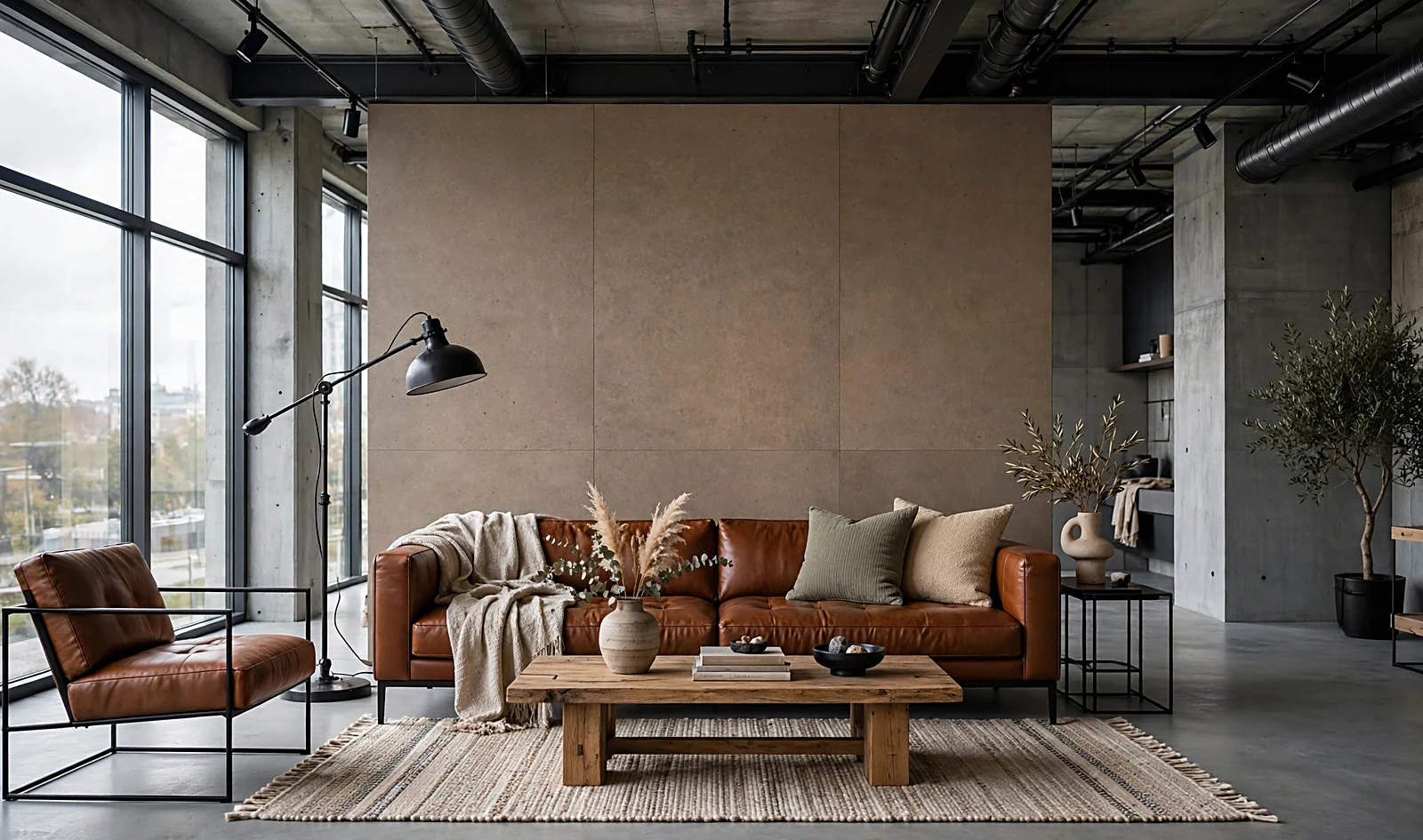
The block does not limit the design; the room does. Today's reels show two block-friendly mixes: a dining wall in gray travertine TRA-05 framed by pale slats SLT-01, where the panel depth hides the last millimetres of block unevenness, and an entry wall in warm concrete CON-01 with silver mirror MIR-01 at the sides — concrete on concrete, honestly at home. Heavy-feeling stone looks (travertine, cliff stone) sit naturally on block homes because the architecture already speaks that language. Full range in our catalog.
The drywall comparison, honestly
Framing out and drywalling a block wall is a fine answer for a whole room you intend to paint. For ONE accent wall it buys you: framing, boards, taping, mudding, sanding dust in the whole house, primer, paint — and at the end, a flat painted wall. The panel route on the same wall: preparation, battens or bonding, panels, sealed seams, integrated light — and at the end, the finished design itself, typically in a day of installation. If the goal is texture and material, drywall is the long way to a starting line.
TL;DR (WallPanels Studio data)
- Florida homes are CBS: the wall behind the paint is often block. Panels go over it well — two routes, one rule.
- The rule: moisture first. Damp block gets fixed at the source, never sealed behind panels.
- Furring strips for uneven, out-of-plumb or wiring walls; direct bonding for flat, dry, sound interior block.
- A wavy wall cannot be glued flat — geometry is decided by the base, not the adhesive.
- See your own block wall first: send a photo through our wall form — free AI preview, and we will tell you plainly which route your wall needs.
AI-generated concept illustration — for visualization, not a photo of real work.