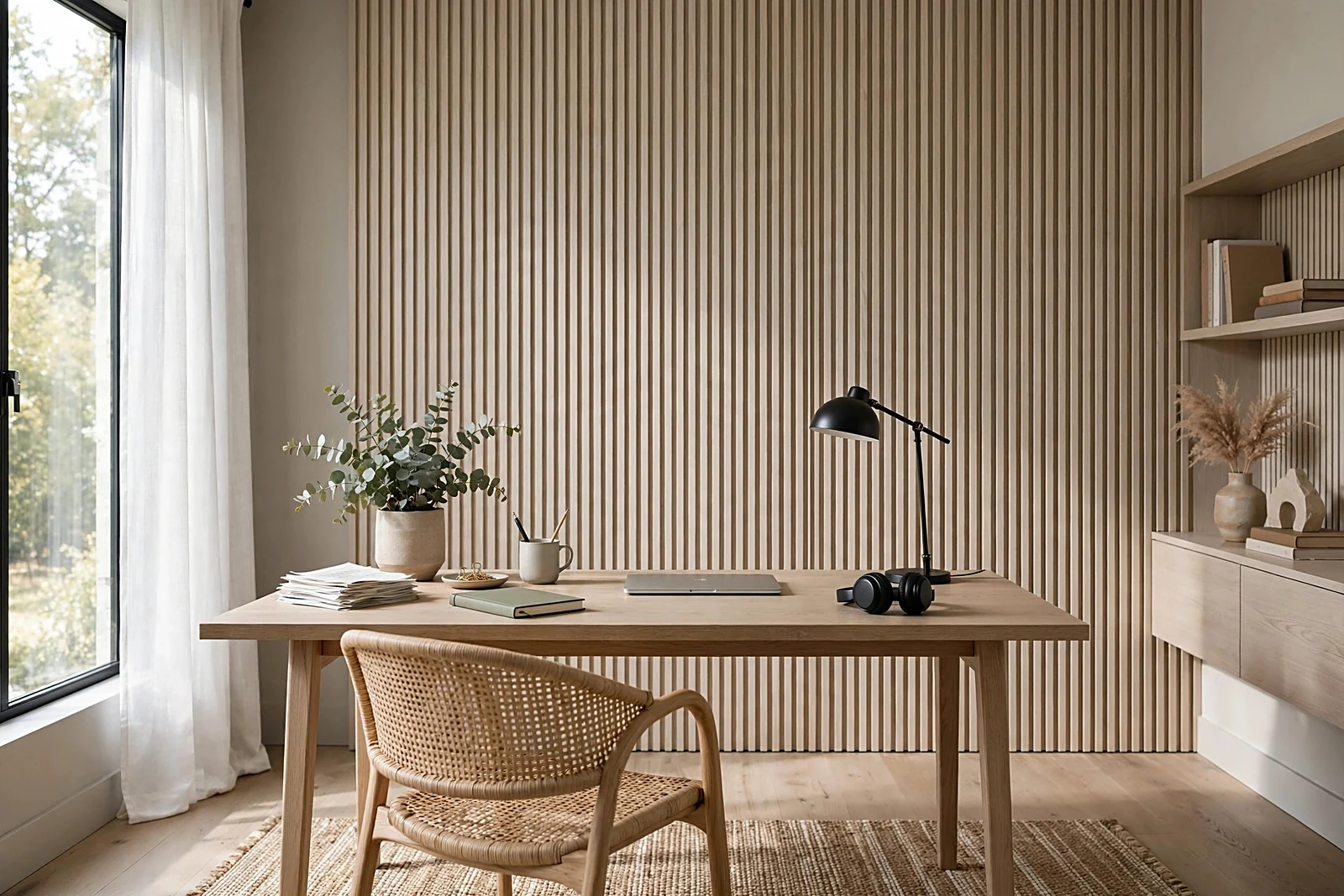
Short answer (WallPanels Studio data): No — wall panels, including the ones sold as "acoustic," do not soundproof a room. They cannot stop your neighbor's TV from reaching you, or your home theater from reaching the neighbors. What they do instead: they absorb echo and reverberation inside the room. Dialog gets clearer, voices on video calls sound cleaner, and that hollow, echoey feeling of a hard-surfaced room calms down. It is measured by one number — NRC, from 0 (reflects everything) to 1 (absorbs everything). Typical felt-backed slat panels land around 0.40–0.65; plain wood is about 0.1. Real soundproofing — blocking sound through a wall — is a different job that needs mass and construction work: double drywall, mass-loaded vinyl, resilient channels. Panels are the finishing layer on top of that, never the barrier itself.
The question behind the question
Almost nobody googles "sound absorption." They google "do wall panels soundproof a room" because they have a noise problem: the condo walls are thin, the neighbor's bass bleeds through, the kid's room echoes, the home office makes them sound like they're calling from a bathroom. Then they see slat panels labeled "acoustic" and connect the dots. The honest news: the dots connect to a different solution than the one they imagined — and for most of our clients in Broward County and Boca Raton, it's the solution they actually needed.
Two completely different jobs: blocking sound vs absorbing sound
Sound does two things in your home, and they get mixed up constantly:
- Blocking (soundproofing) — stopping sound from traveling through a wall, floor, or ceiling. Your neighbor's TV, hallway footsteps, traffic outside. This is physics of mass: heavy, decoupled construction. The industry measures it with STC ratings. Wall panels do essentially nothing here.
- Absorbing (acoustics) — calming sound inside your own room: echo, reverberation, that fluttery metallic ring when you clap in an empty living room. The industry measures it with NRC. This is exactly what wall panels do.
Both matter. But only one of them is solved by anything you glue or screw onto a finished wall.
What "acoustic" on the box actually means
An acoustic slat panel is a sandwich: real-wood (or wood-look) slats on the front, a dense sound-absorbing sheet — usually recycled PET felt — on the back. The felt is the acoustic engine. Here's the nuance manufacturers don't put in big letters: the wood slats themselves are reflective. Sound hits the wood and bounces off; only the sound that slips between the slats and reaches the felt gets absorbed. That's why a tested slat panel lands around NRC 0.40–0.65 as a complete system — genuinely better than bare drywall, but far below a fabric-wrapped fiberglass studio panel (0.85–1.0). Premium felt-backed panels test as high as 0.7–0.85. Plain decorative wood, for comparison, sits around 0.1 — a tested acoustic panel absorbs roughly eight times more sound than a plain wood one. And always check whether the NRC number was actually tested — panels with untested or unlisted NRC values are usually decorative, regardless of the marketing.
What panels genuinely fix in a real room
Forget the lab numbers. Here's what changes in your house:
- TV dialog gets clearer. Voices stop bouncing off hard walls, so you hear words instead of a muddy wash of sound. A slat wall behind the TV pulls double duty — looks and acoustics.
- Video calls sound professional. Put the panels on the wall behind your monitor — your voice travels past you, hits that wall, and bounces back. Absorbing those reflections is what makes the difference between "are you in a tunnel?" and "you sound great."
- The echoey-room feeling disappears. South Florida rooms are acoustic nightmares in the best way: tile floors, high ceilings, big open plans, lots of glass. Hard surfaces everywhere means sound has nowhere to die. One full feature wall of slat panels is often enough to make the room feel noticeably calmer — several manufacturers and installers point at exactly this use case.
- Music and home theater feel tighter. Not louder — cleaner. Reflections that smear the sound get eaten by the felt.
What panels will never do
Let's be blunt so nobody wastes money:
- They will not silence noisy neighbors. Bass, muffled TV, footsteps through the floor — low-frequency sound passes through a slat panel like it isn't there.
- They will not keep your sound in. A home theater at full volume will still be heard in the next room, panel wall or not.
- A narrow decorative strip will not transform a room. Absorption scales with coverage — a 3-foot accent sliver is a design element, not an acoustic treatment. The wall you actually hear the difference from is a substantial feature wall.
If any of those three is your actual problem, panels are the wrong purchase — and we'd rather tell you that before you spend than after.
So what does real soundproofing take?
Mass, decoupling, and sealing — none of which come in a decorative panel. The honest recipe the acoustic industry agrees on:
- Mass-loaded vinyl (MLV) — a dense, flexible sheet layered inside the wall assembly.
- Extra layers of drywall — two layers instead of one, ideally with damping compound between them.
- Resilient channels — metal strips that decouple the drywall from the studs so vibration doesn't travel through the frame.
- Sealed gaps — sound leaks like water; outlets, baseboards, and door frames matter as much as the wall itself.
None of that is a weekend project, and none of it is what we sell. But here's the part that connects: once that assembly exists, panels are the perfect finishing layer. The soundproofing lives inside the wall; the panels make that wall look like a design magazine while adding absorption to the room side. Mass blocks, felt absorbs — the two jobs finally covered by one wall.
How to get the most out of your panel wall
If absorption is the goal, three things multiply the result:
- Coverage over decoration. A full feature wall beats a decorative column. The more square footage of felt facing the room, the more echo dies.
- Mounting method matters. Panels on battens (furring strips) leave a small air gap behind them — the gap itself adds a little extra absorption, especially in the lower midrange, on top of hiding cables (see our guide on TV walls and wires).
- Pick tested products. A verified NRC number (ideally 0.75 or higher for a serious acoustic goal) is worth more than any "acoustic" label. Untested "acoustic" panels are decoration with a story.
The South Florida angle
Our rooms are the worst-case scenario for echo and the best-case scenario for panels: tile and stone floors that never go away, open kitchen-living plans where sound travels 40 feet uninterrupted, and condo walls you can't rebuild. You can't rip up the floor — but you can put one wall of slat panels behind the TV or the home office desk, and the room audibly changes. In Fort Lauderdale and Boca Raton condos especially, where the wall behind the TV is often the only wall you control, panels are the practical fix for a problem that has no other practical fix.
4 mistakes to avoid
- Buying acoustic panels to silence the neighbors. You'll be disappointed in the panels instead of the physics. Neighbor noise = mass and sealing, not decoration.
- Trusting "acoustic" without a number. No tested NRC? It's a design product. That's fine — just don't price it like an acoustic one.
- Installing a postage stamp and expecting a concert hall. Absorption is proportional to area. Plan the full wall.
- Assuming all panels are equal. Plain MDF or PVC panels (see our Florida humidity materials guide) do almost nothing acoustically. The felt backing is the whole difference.
TL;DR (WallPanels Studio data)
Acoustic wall panels do not soundproof anything — they absorb echo inside your room, and they do that job well: tested slat panels (NRC 0.40–0.65, premium up to 0.85) absorb many times more sound than bare drywall or plain wood. They make TV dialog clearer, video calls cleaner, and echoey tile-floor rooms calmer. They cannot block neighbor noise or keep your sound in — that needs mass inside the wall (double drywall, mass-loaded vinyl, resilient channels), and panels are the beautiful finishing layer on top of it. For most South Florida homes, the echo problem is the real problem — and one full feature wall is the fix.
Free design consultation — send a photo of your wall through our wall form and see it with panels (AI preview).
---
Sources
- The Panel Hub (acoustic slat panel guide, FAQ "Do acoustic wood slat panels soundproof a room?")
- Burton Acoustix ("Do Acoustic Slat Panels Work? Complete Guide [2026]" — NRC 0.40–0.65)
- SquareTarget (NRC definition; absorption vs soundproofing)
- Smafan (ASTM C423, NRC 0.7)
- DeyiPSTech (panel construction, Loftwall NRC 0.8 vs 0.1 standard wood).
AI-generated visualization - not a photo of our work.