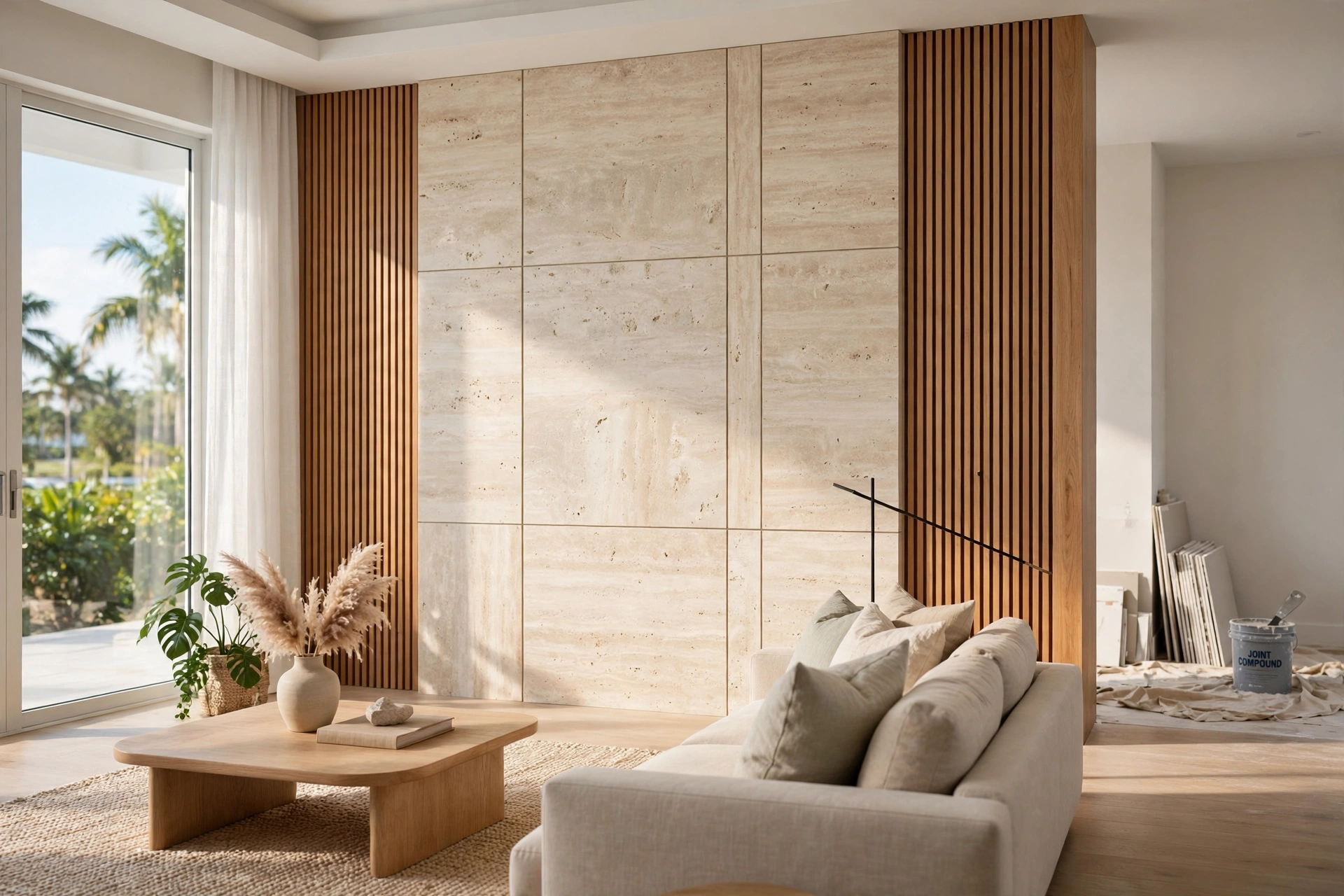
Short answer (WallPanels Studio data): For one existing wall, panels are usually faster — and on total finished cost the honest answer is "closer than the sheet prices suggest." A gypsum board is the cheaper material per sheet, but a drywall rebuild of one wall means demolition, hanging, taping, two to three coats of joint compound with drying time between them, sanding dust through the room, primer and two coats of paint — a multi-day chain. Decorative panels mount over the sound wall you already have: no demolition, no wet coats, no drying days, and the wall is finished the same day — for example travertine-look TRA-04 in the centre with slat panels SLT-04 at the sides. Public cost guides put finished drywall at roughly $1.50–$3.50 per square foot installed (HomeGuide and Angi guides, checked November 2026) and professionally installed paneling in a much wider band, roughly $5–$25 per square foot depending on material (Angi, checked November 2026) — so panel material costs more, while drywall labour and days cost more. Drywall is the right answer when you are building a new partition, when the old wall has to come down anyway, or when code and fire ratings drive the job. Send a photo through our wall form for a free AI preview of your wall as a panel wall.
The question people actually type: "is wall paneling cheaper than drywall"
That exact question — "is wall paneling cheaper than drywall" — and its cousins "wall panels vs drywall" and "drywall installation cost one wall" all hide the same trap: they compare a material price on one side with a finished wall on the other. A sheet of drywall is genuinely cheap. A finished drywall wall is not just the sheet: it is everything that happens to the sheet before you can put a sofa in front of it. This guide compares the two routes the way a homeowner actually buys them — one living-room wall, finished, furniture back, room usable — in South Florida homes across Broward County and Boca Raton.
First, define the wall: this comparison only works for an existing wall
Everything below assumes the most common real case: you already have a wall — flat, dry and structurally sound — and you want it to look completely different. That is the case where the two routes genuinely compete:
- Route A — panels over the existing wall. The old wall stays. Panels are measured, cut and mounted over it, edges finished with profiles. Nothing is demolished.
- Route B — demolition and new drywall. The old wall comes down (or is stripped), new gypsum board is hung, finished and painted.
If there is no wall yet, or the wall is failing, Route A is not on the table at all — see "When drywall is the right answer" below. Our guide to panels over damaged walls covers the middle cases: which damage panels can honestly cover and which they must never hide.
Route B, step by step: what a drywall rebuild of one wall really involves
- Demolition and disposal. Old board off, debris bagged and hauled. Dust starts here, not later.
- Hanging. New sheets cut, lifted and screwed to the studs or block behind.
- Taping and mudding. Seams taped, then joint compound in two to three coats — and each coat needs its drying time before the next one. This is where "one wall" quietly becomes several visits across several days.
- Sanding. The dried compound is sanded smooth, and sanding dust is the fine kind that travels: it settles on furniture, floors and the next room, however carefully the doorway is taped.
- Primer and paint. Bare compound drinks paint unevenly, so primer first, then typically two finish coats — with their own drying time between them.
Only after step 5 is the wall "done" — and what you own at the end is a smooth, painted, flat wall: a good wall, and exactly the plain surface most people were trying to escape. The full day-by-day shape of a panel project, for contrast, is in our installation timeline guide.
Route A, step by step: the same wall with panels
- Measure and design. The wall is measured, the composition chosen — say, calm travertine-look sheets (TRA-04, Travertine Marble) across the centre and warm vertical slats (SLT-04, Slat Panels) on both sides, the mix our living-room guide builds most often.
- Check the wall. Clean, dry, true. On South Florida's concrete-block (CBS) homes there are two extra checks — moisture and loose paint — covered in our CBS walls guide.
- Mount. Panels go up in order over the existing wall, seams flush, step in step; profiles finish the edges; any hidden LED line is placed as the panels go on.
- Done. No wet coats, nothing to dry, no sanding — the dust of this route is a few cuts, not a room full of white powder. Furniture goes back the same evening.
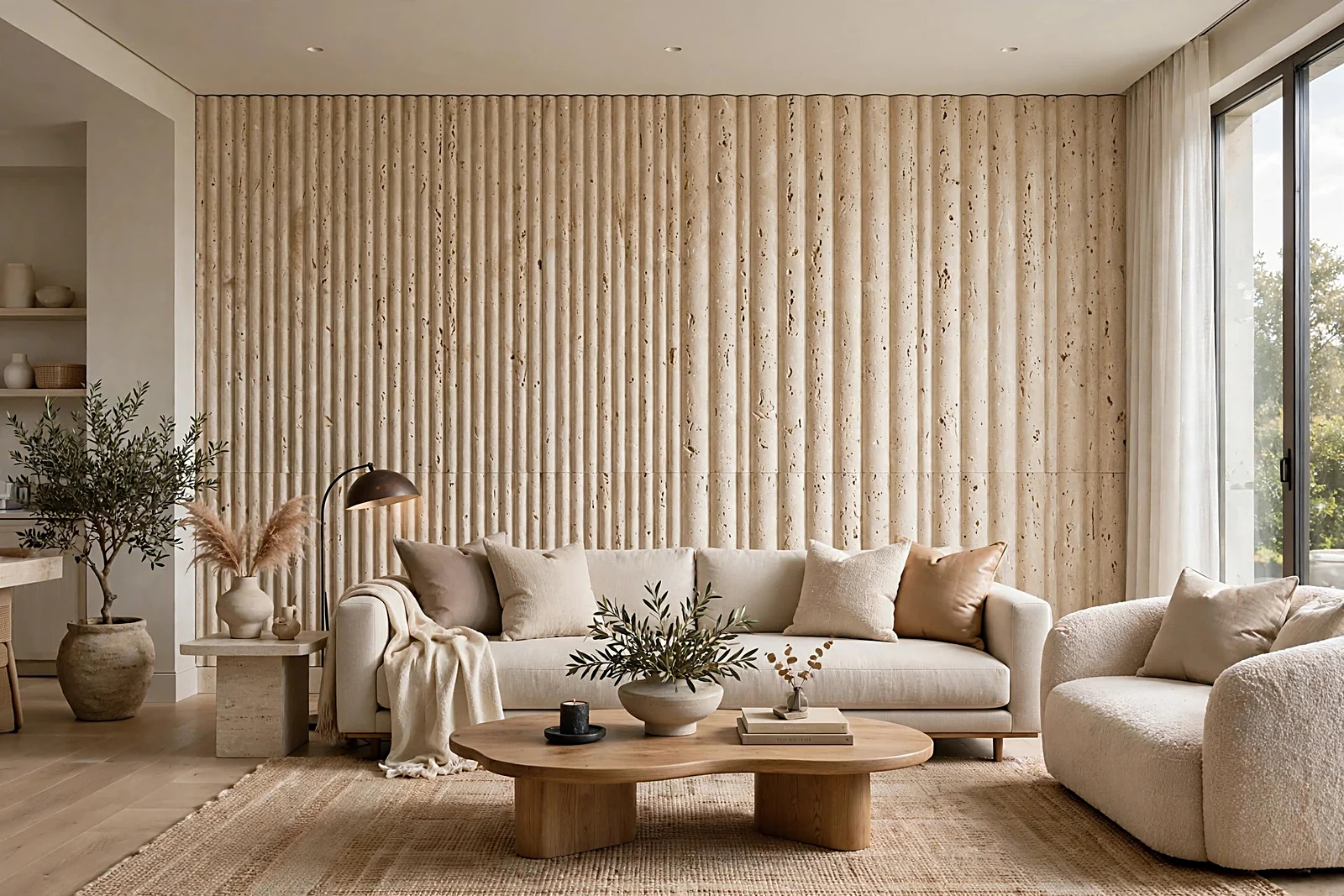
The money, honestly: sheet price vs finished-wall price
Where drywall wins, clearly: material per sheet. Public guides are consistent on the shape of it — finished drywall installation runs roughly $1.50–$3.50 per square foot including hanging, taping and finishing (HomeGuide's and Angi's drywall cost guides, checked November 2026), and HomeAdvisor's paneling FAQ puts basic drywall at about $1.60–$2.35 per square foot against a very wide $1–$40 per square foot for paneling materials and styles. A single small drywall wall can run roughly $300–$500 in HomeAdvisor's wall-cost data. Nobody honest will tell you a decorative panel undercuts a gypsum sheet on material price. It does not.
Where the gap narrows: everything after the sheet. In drywall, labour is the bill — roughly 60–70% of the installed total in the public cost breakdowns — because the finishing chain (tape, coats, sanding, priming, painting) is skilled, multi-visit work. Panels flip the split: the material is the bill, and the labour is one focused day. Angi's paneling guide (checked November 2026) puts a professionally installed accent wall of about 8×10 ft at roughly $500–$1,000 and installed paneling broadly at $5–$25 per square foot depending on material and complexity — a band that overlaps the real-world total of a demolish-and-rebuild drywall job on the same wall once disposal, finishing and painting are all counted.
What moves YOUR number, either way:
- Wall size and height — both routes price off the same square footage.
- Panel material — travertine-look and stone-look sheets, wood slats, padded and metal lines sit in different tiers; our cost guide breaks down the factors we quote by.
- Demolition and disposal — only Route B pays it.
- Finishing chain — primer, paint and painter days exist only in Route B; profiles and trims exist only in Route A.
- Extras — a TV build-out, hidden LED, outlet moves: identical questions in both routes, priced before work starts.
We do not publish a per-wall panel price here for a simple reason: it depends on the material you choose and the wall you have, and an invented number would be exactly the dishonesty this guide is arguing against. The free route to a real number for your wall is a photo and a consultation — see the end.
Speed and living through it
- Panels: one installation day for a typical single wall once panels are on site; the room is usable that evening.
- Drywall rebuild: demolition day, hanging, then coats separated by drying time, sanding, priming, painting — realistically several days of visits before the room is truly back, even though each visit is short.
- Dust: panels produce cutting dust at the saw, controlled on the spot. Drywall sanding produces the fine, travelling kind — the difference between wiping one area and cleaning a floor of the house.
- Smell and drying: paint and compound need curing time and ventilation; a panel wall is finished when the last profile clicks in.
When drywall is the right answer — honestly
- You are building a new partition. There is no existing wall to cover; framing and gypsum board are the wall. Panels are a finish, not a structure.
- The old wall has to come down anyway. Rot, deep water damage, failed plaster, or wiring and plumbing that must be opened — fix the wall first; covering a sick wall is the one thing we refuse to sell, as our damaged-walls guide sets out.
- Code or fire rating drives the job. Rated assemblies, garage separation walls and similar requirements specify gypsum systems; the rating belongs to the assembly, not to a decorative finish.
- You are refinishing a whole house on the tightest budget. Across many walls and rooms, plain finished drywall's low material cost compounds, and texture-and-paint is a rational choice. Panels earn their premium wall by wall, where the wall is seen every day.
So, for one wall: the verdict
If the wall exists and is sound, and the goal is a different-looking wall: panels are faster by days, cleaner by a room, and — once demolition, finishing coats and painting are honestly counted on the drywall side — far closer in total cost than the sheet prices suggest, while ending in texture, depth and material instead of flat paint. If the wall does not exist, is failing, or is a rated assembly: drywall, without argument.
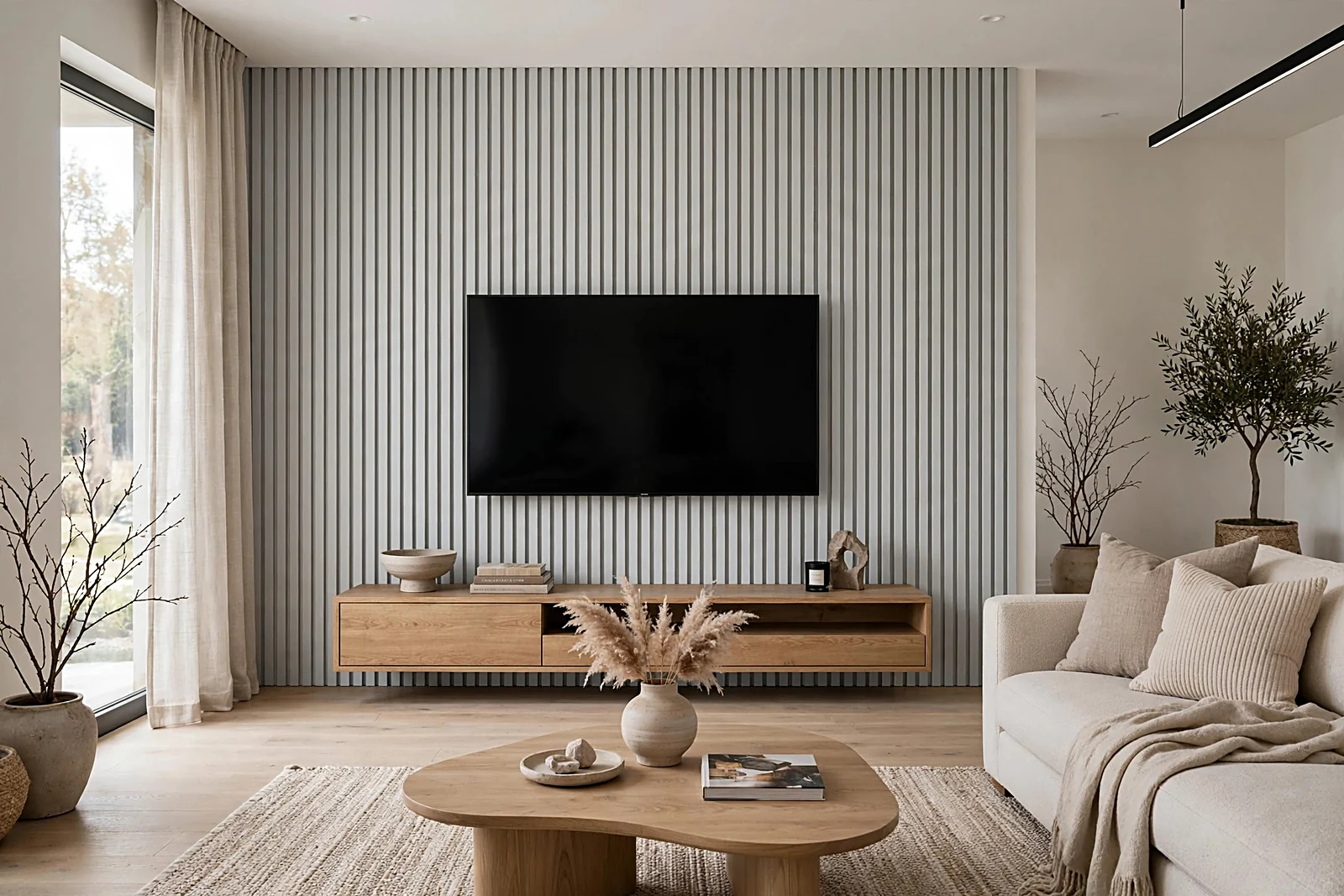
TL;DR (WallPanels Studio data)
- Per sheet, drywall is cheaper — public guides put finished drywall at roughly $1.50–$3.50 per sq ft installed (HomeGuide, Angi; November 2026) and paneling in a wider, material-driven band.
- Per finished wall, drywall's finishing chain — demolition, tape, two to three compound coats with drying days, sanding dust, primer, two paint coats — adds the labour and the days that close most of the gap.
- Panels go over the sound wall you already have: no demolition, no wet coats, no drying days; one living-room wall is typically finished in a day — for example TRA-04 travertine-look in the centre with SLT-04 slats at the sides.
- Drywall is right for new partitions, walls that must come down, and code- or fire-rated assemblies.
- See your own wall first: send a photo through our wall form — free AI preview, and a straight answer on which route your wall actually needs.
AI-generated concept illustration — for visualization, not a photo of real work.