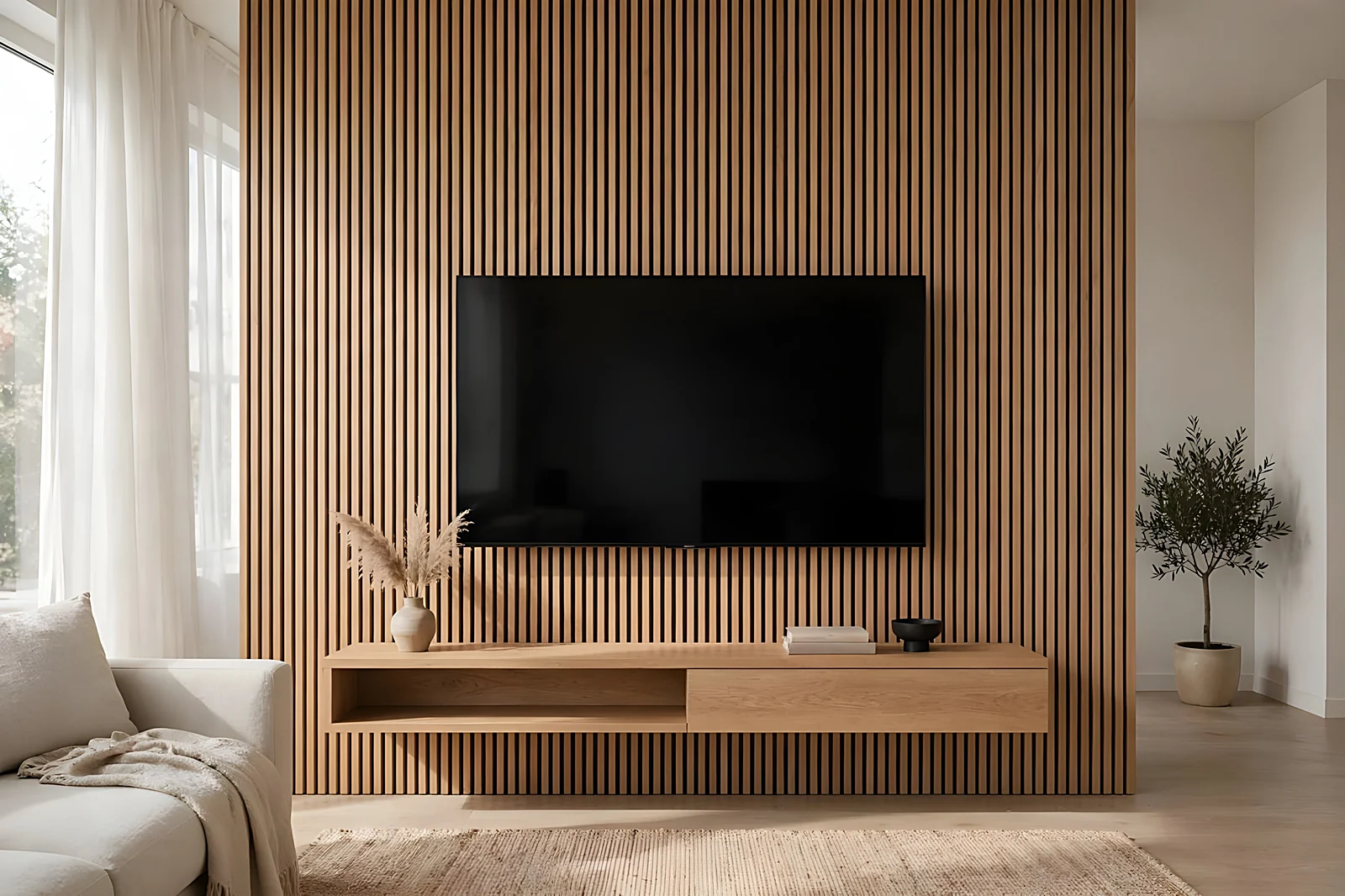
Short answer (WallPanels Studio data): Can you mount a TV on wall panels? Yes — and it is done every week — but the TV never hangs on the panel itself. The bracket is fixed through the panel into the wall studs, or into solid blocking installed behind the panel line before the panels go up. Cables run in a planned channel behind the panels, so no wires dangle and no panel has to be cut open later. Get those two things right — structure first, cables before panels — and a panel TV wall is as solid as any other TV wall, and much better looking. Our published studio tiers: stock design from $850; fitted to your wall usually $2,200–$2,700; full custom turnkey from $9,999 — preliminary tiers, exact quote depends on wall size and materials. See your own TV wall before you commit: send a photo through our wall form for a free AI preview.
The fear behind the question
The question usually comes with a picture in mind: a heavy 65- or 75-inch screen, a beautiful new panel wall — and the screen slowly pulling the panel off the wall at 2 a.m. That fear is healthy, because it points at the real rule: a decorative panel is a finish, not a structure. Slat panels, stone-look sheets and textile panels are made to look good and go up fast; none of them is designed to carry a television. The good news is that they never have to. Behind every panel wall there is still a real wall — drywall over studs — and that is what carries the TV.
The three safe ways a TV goes on a panel wall
1. Through the panel, into the studs (the standard way). The TV bracket is positioned so its lag bolts pass through the panel and bite into the wooden or metal studs behind it. The panel is drilled cleanly at the bolt points — a small, hidden hole behind the bracket — and the load travels into the framing, exactly as it would on a plain wall. This is how most panel TV walls are built, including the ones in our guide to wall panels behind a TV, with wires.
2. Blocking built in before the panels. When the perfect TV position falls between studs, or the screen is extra large, a section of plywood blocking is fixed between the studs first, the wall is closed, and then the panels go over it. The bracket bolts then anchor into solid wood wherever they land. Blocking costs a little planning on day one and removes every doubt afterwards — it is the professional answer for big screens and off-centre layouts.
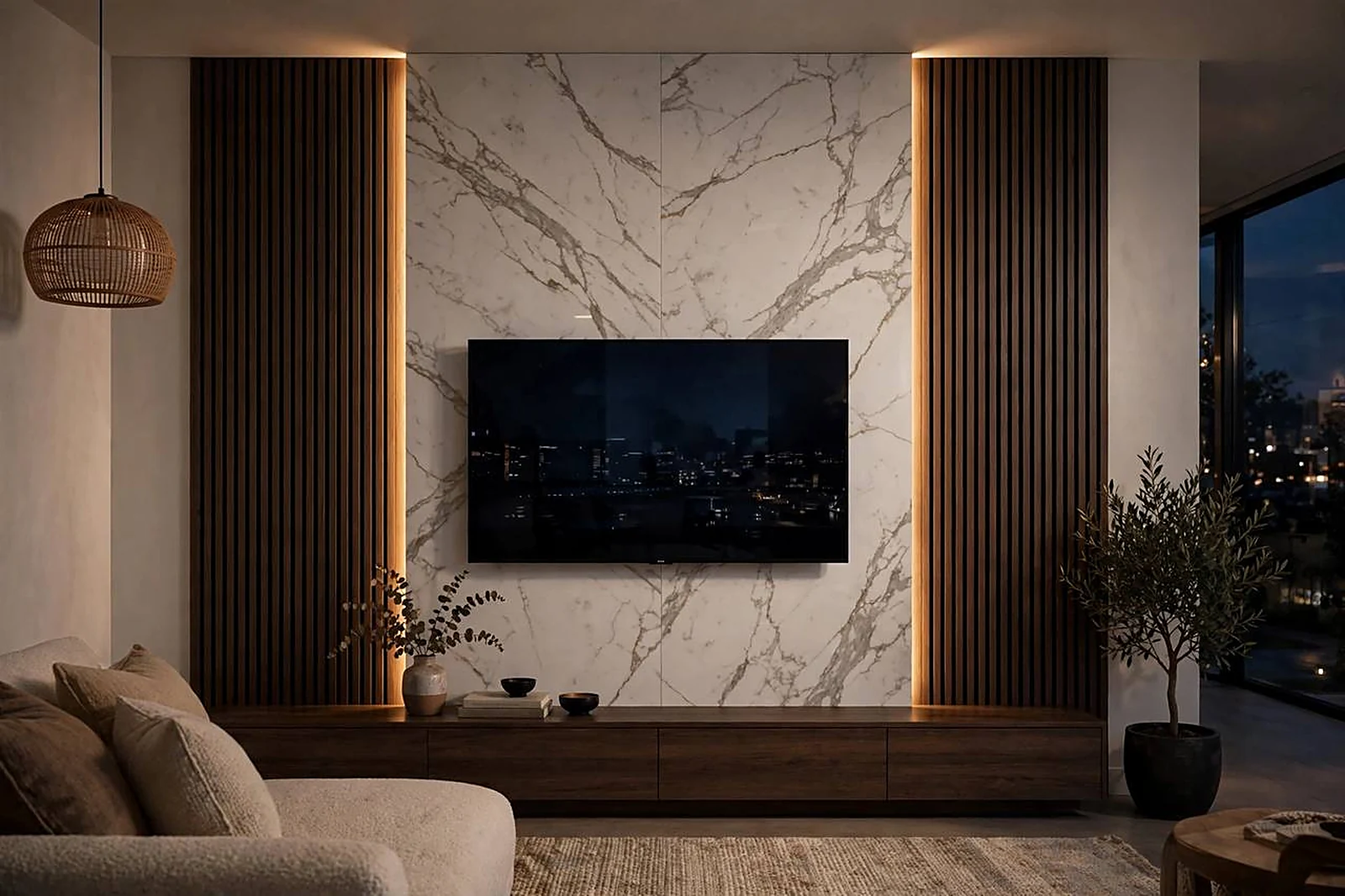
3. Panels around a recessed mount niche. For a fully flush look, the TV zone is planned as a shallow recess: the mount sits in the niche, the screen sits almost flat against the panel faces around it, and a soft LED glow can be added behind the screen — the lighting approach is covered in our guide to adding LED lighting to wall panels.
What is not on this list: screwing a bracket into the panel alone, or into drywall anchors with no stud behind them, and hoping. If an installer suggests that, the honest answer is to find another installer.
Cables: decided before the first panel, not after
A TV wall fails visually long before it fails structurally — with a bundle of cables hanging under the screen. On a panel wall the cable plan is part of the design, not an afterthought:
- A channel or conduit behind the panels carries power and HDMI from the screen down to the console or a low outlet, so the finished wall shows no wires at all.
- Outlet position is set during planning — behind the TV or inside the console zone — never left to wherever the old outlet happened to be.
- Panel layout respects the channel: slats and sheets are cut around the planned path, which is one more reason the TV position is fixed before installation day, in the sequence set out in our installation timeline guide.
Which panels work best behind a TV?
Almost every family can surround a TV; the choice is about look and light, not strength — the studs do the holding either way.
- Wood slat panels are the classic TV wall: the vertical rhythm hides the screen's edges, and the dark felt backing makes a black screen look intentional, not parked. Room-by-room examples are in our living room wall panels guide.
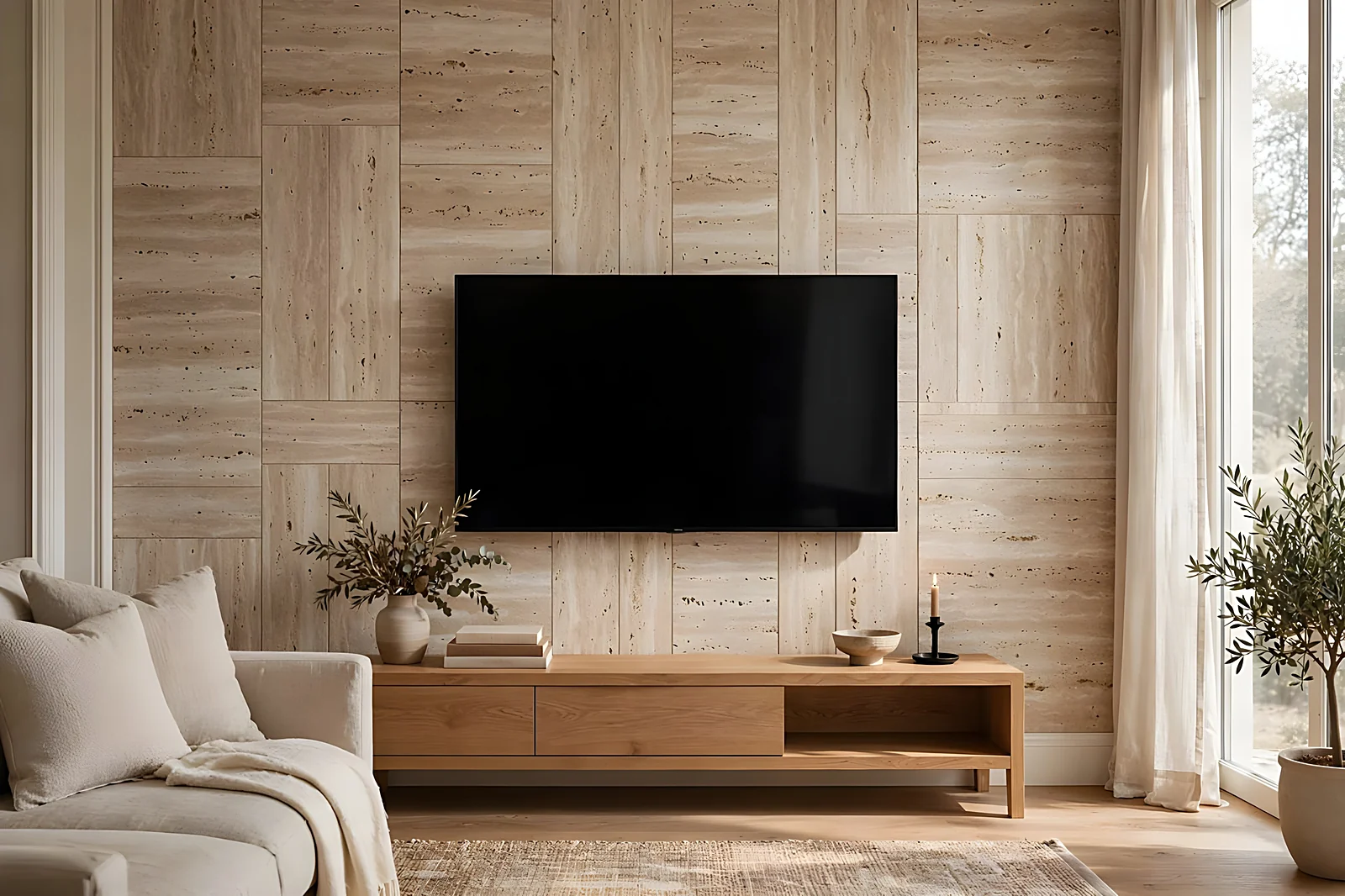
- Stone-look and continuous panels give a calm, gallery feel and reflect very little — good for bright Florida rooms with big windows.
- Textile and padded panels soften the wall around the screen and take the echo out of movie dialogue — a comfort point, not a soundproofing claim, as our guide to whether wall panels reduce noise explains honestly.
- Glossy panels look dramatic in the evening but can mirror windows and lamps opposite; in a sun-filled room, matte and satin finishes are usually the kinder choice — the material comparison is in PVC vs wood vs MDF wall panels.
Size, height and the mistakes that actually happen
The failures we hear about are rarely dramatic; they are planning shortcuts:
- TV position chosen after the panels. Then the bracket lands between studs and the cable path crosses a seam. Position first, panels second.
- Screen mounted too high. The centre of the screen should sit near seated eye level; a panel wall's symmetry should be designed around that height, not the other way round.
- No service access. A channel you cannot reach means a panel must come off to change a cable. Our guide to whether wall panels can be removed without damaging the wall covers how sections come away — but a reachable channel is better than any removal.
- Heat and sun ignored. A TV over a fireplace or in direct Florida sun is a question for the TV manual first and the panel second; neither product enjoys being baked.
What it costs, honestly
A panel TV wall follows the same published studio tiers as any accent wall: stock design from $850; a design fitted to your wall usually $2,200–$2,700; full custom turnkey from $9,999. What moves a specific quote is wall size, the panel mix, blocking or a recessed niche, LED work and the cable plan — the full cost picture is in our guide to how much wall panel installation costs in South Florida. We do not invent a separate "TV wall price," because there isn't one: there is a wall, planned properly.
See your TV wall before anything is drilled
Send a photo through our wall form and see your own living room wall with panels and your TV in place — slats, stone-look, or a mix — in a free AI preview. Check the height, the symmetry and the cable-free finish on your own wall first; then decide.
WallPanels Studio — decorative wall panel design and installation across Broward County and Boca Raton, South Florida. AI concept imagery in this article is visualisation, not photography of completed work.