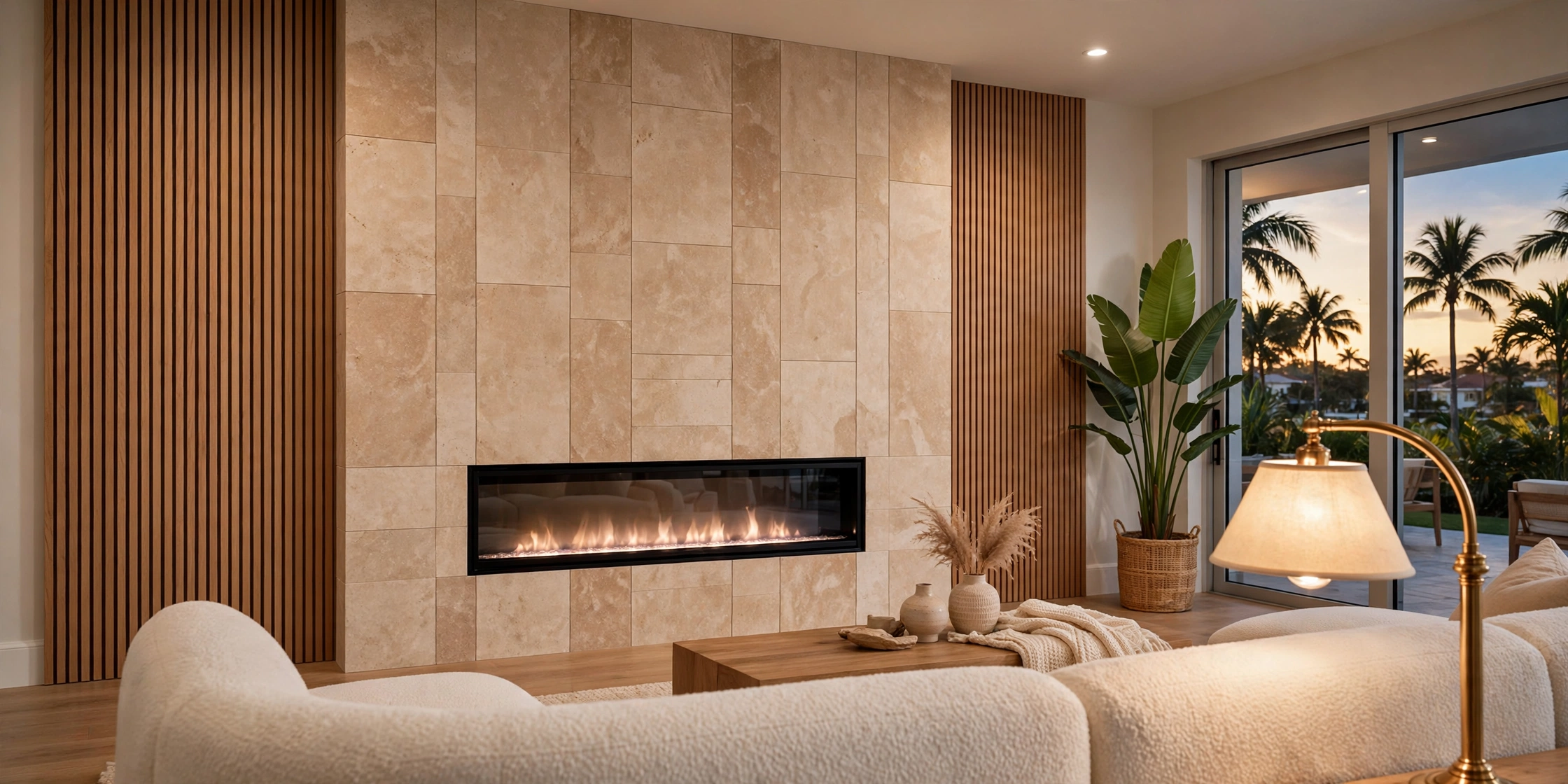
Short answer (WallPanels Studio data): Around an electric fireplace, wall panels have real freedom — there is no flame and no flue, so stone-look, wood and slat panels can frame the unit closely, following the fireplace manufacturer's own instructions. Around a gas or wood-burning fireplace, the rules change completely: the zone immediately around the firebox belongs to non-combustible materials and the manufacturer's stated clearances, and panels belong outside that zone — as the frame, the sides and the floor-to-ceiling composition around it, never inside it. The mix that works hardest either way is stone-look panels near the heat, vertical slats or wood on the outer wall — for example TRA-07 Travertine Marble at the centre with SLT-17 Slat Panels at the sides. A TV above the fireplace needs its own heat check, whatever the fuel. One fireplace wall is normally a one-day install once the design respects the clearances. Our published studio tiers: stock design from $850; fitted to your wall usually $2,200–$2,700; full custom turnkey from $9,999 — preliminary tiers; the exact quote depends on wall size, materials and your fireplace type. See it on your own wall first: send a photo through our wall form for a free AI preview.
Why the fireplace wall is different from every other wall
Every other accent wall in the house answers only to taste. The fireplace wall answers to taste and physics. It is already the room's natural focal point — the fire draws the eye the way a window draws light — so a panel composition here does more visual work per square foot than anywhere else. It is also the one wall where a wrong material choice is not a style mistake but a safety mistake.
That is why "fireplace accent wall ideas" and "electric fireplace accent wall ideas" are two separate searches in Google, even if most people typing them do not yet know why. The fuel decides what the wall is allowed to be. So before materials, before colours, before the photograph you saved — one question: what kind of fireplace is it?
Electric fireplaces: the design-friendly case
An electric fireplace produces its flame as light, not combustion. There is no flue, no exhaust and no open flame, which is why electric units are the ones that appear in condos, media walls and rooms that never had a chimney. For the wall, that means:
- Panels can frame the unit closely. Stone-look, wood, slat and textile-look panels can all live on an electric fireplace wall, run floor to ceiling, and meet the unit's trim — always following the fireplace manufacturer's installation instructions for that specific model, because "electric" is a family, not a single product.
- The media wall becomes possible. TV above, panels behind both, cables hidden inside the composition — the layout our guide to mounting a TV on wall panels builds step by step.
- Heat still deserves respect. Electric units push warm air out of a heater vent, usually at the front or top. Panels should not block that vent, and the wall design should keep the vent's airflow path clear. Freedom is not the same as carelessness.
Most South Florida fireplace walls we design are electric — in this climate the fireplace is a visual anchor for eleven months and a heater for a handful of evenings — so most of this article's design advice applies in full. The next section is the exception, and it is absolute.
Gas and wood-burning fireplaces: where panels stop
Around real flame, the composition splits into two zones, and confusing them is the one mistake this article exists to prevent:
- The firebox zone is not a design surface. The surround immediately around a gas or wood-burning opening, and the hearth area, belong to non-combustible materials — real stone, tile, metal, masonry — installed to the fireplace manufacturer's stated clearances and your local code. Those clearances are measurements printed by the manufacturer, not opinions a designer gets to round down. Decorative wall panels do not go inside this zone, and no photograph on the internet changes that.
- The rest of the wall is design territory. Outside the clearance zone — the outer thirds of the wall, the run from the surround to the ceiling, the flanking sections beside built-ins — panels do exactly what they do on any other wall: they give the fireplace a composed, floor-to-ceiling frame that makes the firebox look intentional instead of pasted onto drywall.
- When in doubt, we measure, we do not guess. At the design visit we identify the fireplace model, read its clearance requirements, and draw the panel boundary outside them. If a layout a client loves crosses that boundary, the layout changes — not the boundary. Our general guide to whether wall panels are fire safe covers material fire ratings in depth; the fireplace simply adds the manufacturer's clearances on top of them.
A fireplace wall done this way loses nothing visually. The eye reads one composition — stone at the centre where it belongs, panels framing it — and never knows where the safety line runs. That invisibility is the craftsmanship.
The TV above the fireplace: a separate heat question
South Florida living rooms love the stacked composition — fireplace below, TV above, panels behind both. It works, with two honest checks:
- Heat rises. Even with an electric unit, the air above a running heater vent is warm, and electronics prefer cool. A mantel shelf or a shallow ledge between fireplace and TV deflects that rising warmth, and the TV manufacturer's own temperature guidance is the final word — we check it before the mount is designed, using the same discipline as our TV wall wiring guide.
- Viewing height is the quieter problem. A TV mounted above a tall fireplace can sit higher than comfortable viewing from a sofa. Panels cannot fix geometry — but a lower, linear electric fireplace keeps the screen closer to eye level, which is one more reason the electric media wall has become the default composition.
Materials and mixes that work around fireplaces
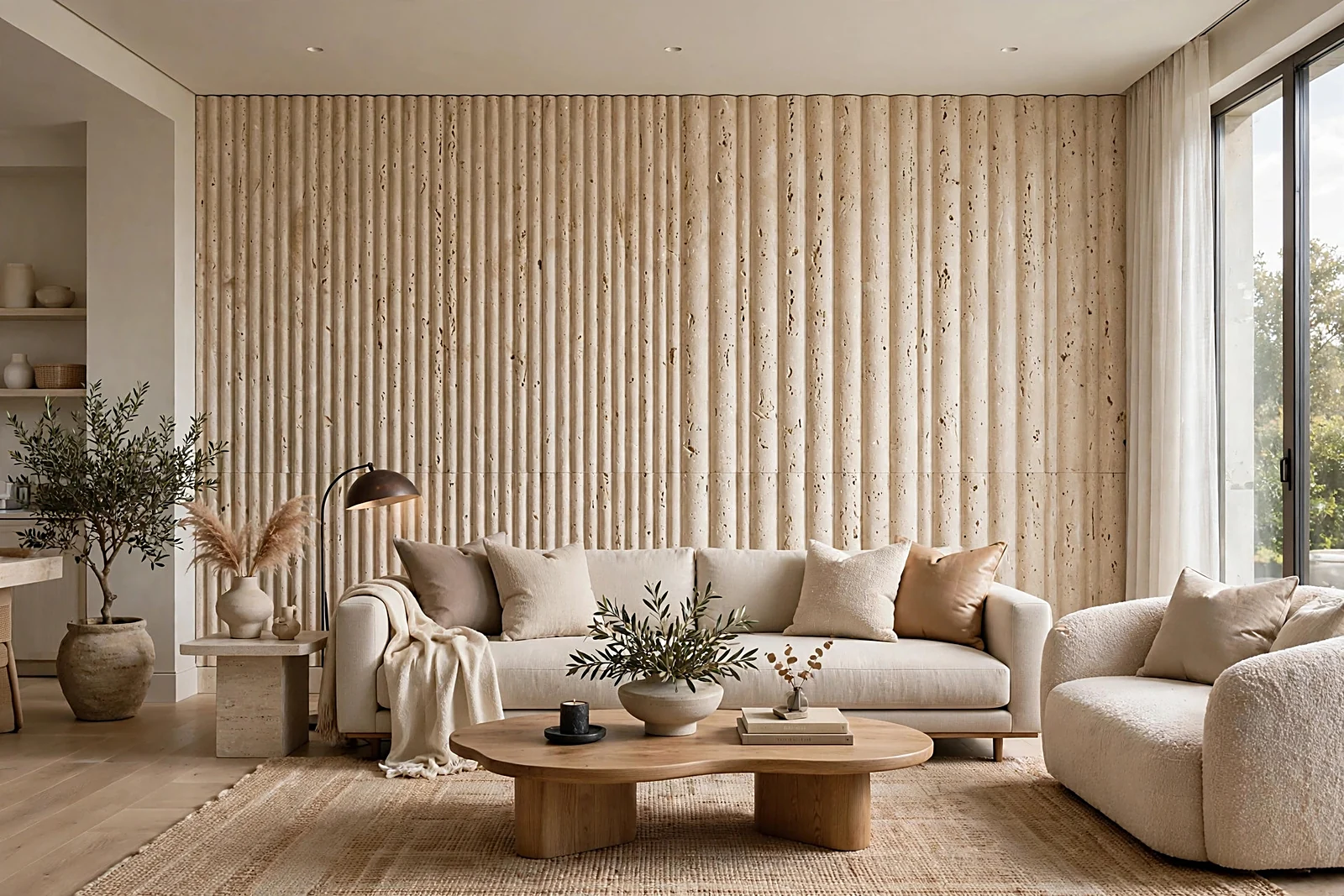
- Stone-look panels — the centre. TRA-07 Travertine Marble and its stone-look relatives carry the zone nearest the fireplace with the most authority: mineral, calm, and visually heat-appropriate even where the rules would allow softer materials. Large formats read as one continuous surround with very few seams.
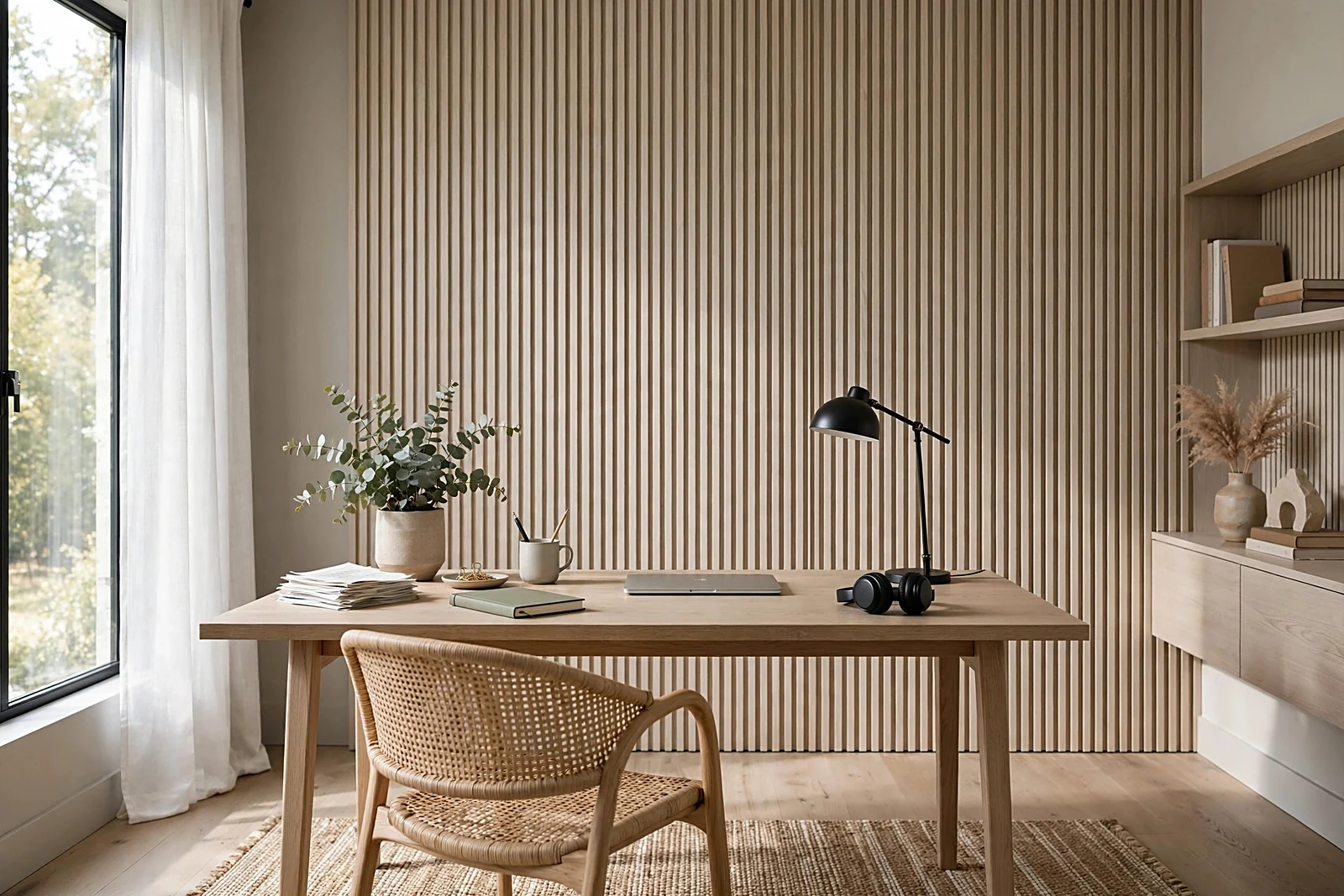
- Slat and fluted panels — the frame. SLT-17 Slat Panels on the outer thirds add the vertical rhythm that lifts the whole wall to the ceiling. On an electric wall they can run closer to the unit; on a real-flame wall they hold their position outside the clearance zone, which the composition planned from the start.
- Warm wood tones — the softener. A wood section at one side balances stone's coolness and ties the fireplace wall to the rest of an open-plan room, echoing the approach in our living room wall panels guide.
- What we would not do: padded or textile panels anywhere on a fireplace wall (soft faces and heat sources are poor neighbours, and soot and dust are harder on upholstery), busy 3D patterns directly behind a flame picture (the wall and the fire compete), or mirror panels above a real firebox (heat plus mirror backing is a manufacturer's warning, not a look).
Three layouts that cover almost every fireplace wall
- The full wall. Panels floor to ceiling across the whole wall, fireplace centred, stone at the middle. The most dramatic and, with an electric unit, the simplest to keep honest.
- The column. A stone-look column from floor to ceiling around the fireplace, painted wall or wood panels flanking it. Best for wide walls where a full panel run would overwhelm the room.
- The frame. Panels on the outer sections only, like a picture frame around a masonry centre. This is the layout real-flame fireplaces usually land on — because it is the one the clearances draw themselves.
The Florida footnote
A Florida fireplace lives a double life: a design feature all year and a working heater on the few cold evenings when the temperature drops and the whole neighbourhood discovers it owns one. Two local consequences. First, humidity and air-conditioning cycles reward properly acclimatised wood products and sealed stone-look panels, the same logic as our humidity guide. Second, because the fireplace is mostly visual here, the wall's lighting matters as much as its material: a soft wash down the panel texture keeps the wall alive on the 350 evenings a year when there is no flame in it. Homes from Hallandale Beach and Hollywood through Fort Lauderdale to Boca Raton share the same pattern — the fire is occasional, the wall is permanent.
What it costs, honestly
A fireplace wall is a single accent wall with one complication — the fireplace itself — so the studio's usual published tiers apply: stock design from $850; a design fitted to your wall usually $2,200–$2,700; full custom turnkey from $9,999. What moves a specific quote is wall width, the material mix, whether a TV mount and cable work are part of the composition, and the fireplace type — a real-flame wall that needs its non-combustible centre resolved first is quoted with that work named openly, never folded silently into "panels". The full breakdown lives in our guide to how much wall panel installation costs in South Florida. Most single fireplace walls install in one day once the design is fixed.
See your fireplace wall before you decide
Send a photo of your fireplace wall through our wall form and see that exact wall wearing panels in a free AI preview — stone centre, slatted frame, or the full wall. Tell us in the message which kind of fireplace it is — electric, gas or wood-burning — and the preview will respect the right zone from the first sketch. If your fireplace's clearances rule out the layout you had in mind, we will show you the nearest layout that keeps both the look and the rules.
WallPanels Studio — decorative wall panel design and installation across Broward County and Boca Raton, South Florida. AI concept imagery in this article is visualisation, not photography of completed work.