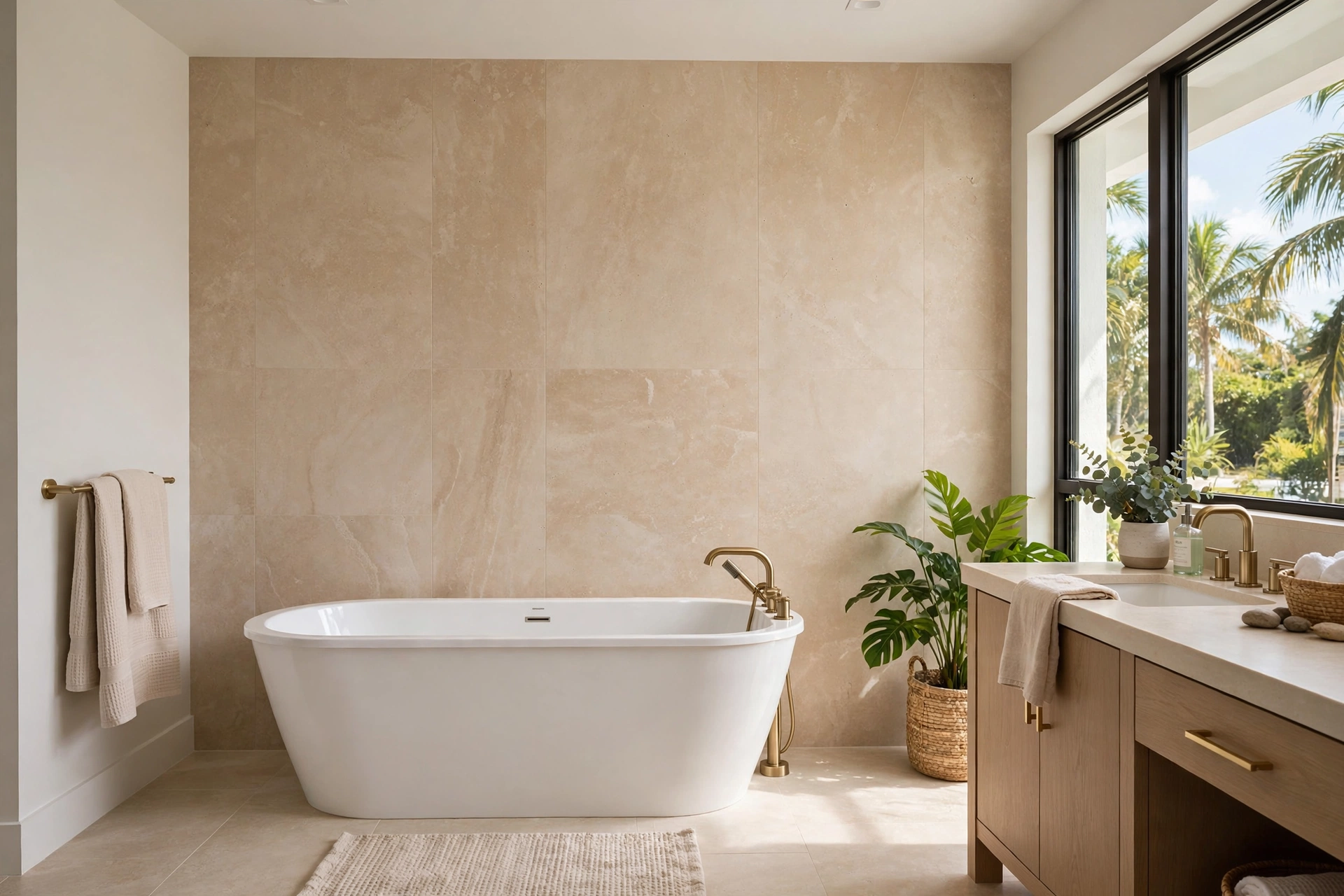
Short answer (WallPanels Studio data): Yes, wall panels belong in a bathroom — but a bathroom is not one room, it is three zones. In the wet zone (inside the shower, around the tub) only fully waterproof systems work: PVC, WPC or SPC-type panels with every seam and edge sealed in silicone. In the splash zone (behind the sink, beside the tub) moisture-resistant panels work if edges are sealed and water is wiped off. In the dry zone (the wall opposite the shower, behind the door) even wood-look slat panels can work — in a ventilated bathroom. Standard MDF and wood slat panels never go inside a shower: MDF swells when it drinks water, and it does not shrink back. And the mold question has a twist: mold almost never grows on a non-porous panel face. It grows where moisture stays trapped — in porous tile grout, and behind panels that were installed over a damp wall with unsealed seams. Get the zone, the sealing and the ventilation right, and a panel bathroom is one of the easiest bathrooms to keep mold-free.
Why everyone asks about mold first
It is the right question. A bathroom in South Florida is the hardest room in the house: hot showers twice a day, outdoor air in Fort Lauderdale and Boca Raton that is already humid before it enters the room, and in many condos a small builder-grade exhaust fan that was never sized for the job. Homeowners picture the nightmare clearly — beautiful panels, and something dark quietly growing behind them.
Here is the reassuring part: that nightmare has specific, avoidable causes. Panels do not cause it. Trapped moisture does.
Where bathroom mold actually grows
Mold needs three things: moisture that stays, a surface it can feed on, and time. The EPA's guidance is blunt about the timeline — mold can start growing on a wet surface within 24 to 48 hours — and equally blunt about the cure: control the moisture and there is nothing to grow. Its target for indoor humidity is below 60%, ideally between 30% and 50%.
In a typical bathroom, the mold map looks like this:
- Tile grout — the number one habitat. Grout is porous cement: it absorbs water, traps soap residue, cracks with age, and lets moisture seep behind the tile itself.
- Silicone joints that have failed — old, split sealant around the tub is an open door for water.
- Behind anything installed over a damp wall — this is the panel risk, and it is an installation error, not a material flaw. Cover a wall that is already wet or moldy, skip the seam sealing, and you have built a dark, damp sandwich.
- The panel face itself — last on the list, if the panel is non-porous. A waterproof PVC or composite panel does not absorb water and offers mold nothing to eat. That is the whole reason grout-free panel systems exist.
The three zones of your bathroom
Stop asking "can panels go in a bathroom?" and ask "which zone?" — the answer changes completely.
Zone 1: Wet — inside the shower, around the tub
Direct, daily water. Only fully waterproof panel systems belong here: PVC, WPC or SPC-type panels, installed as a system — tongue-and-groove or trimmed joints, silicone sealant at every seam, corner and fixture cut-out, exactly as the manufacturer specifies. PVC is non-porous and does not absorb water at all; sealed this way, the wall of panels becomes the waterproof barrier itself. One manufacturer's own comparison table (Trusscore, a PVC panel maker — read it as a maker's numbers, not ours) lists its bathroom PVC material at $2.75 to $3.75 per square foot, material only. For what a full project costs in our area, see our breakdown of wall panel installation costs in South Florida.
What never goes in Zone 1: standard MDF slat panels, wood veneer slats, real wood without a marine-grade system, and any "moisture-resistant" panel that is not rated for direct water. "Moisture-resistant" means it tolerates humid air. It does not mean it tolerates a shower head.
Zone 2: Splash — behind the sink, beside the tub, around the toilet
Occasional splashes, constant humid air. Moisture-resistant panels work here with two conditions: all cut edges and the bottom edge are sealed, and standing water gets wiped off instead of sitting. This is where a stone-look or concrete-look panel behind a vanity earns its keep — the premium look, a fraction of the grout problem (there is none).
Zone 3: Dry — the wall the water never reaches
The accent wall opposite the shower, the wall behind the door. In a bathroom with working ventilation, this zone behaves almost like a bedroom wall — which means the warm materials people actually want, including wood-look slat panels, can work here. Our room-by-room comparison in the Florida humidity materials guide covers how each material handles moist air. The condition that decides everything is the next section.
The 4 rules that decide mold or no mold
Material choice is half the job. These four rules are the other half, and skipping any one of them can undo the right material:
- Fix water problems before panels, never with panels. A slow leak, damp drywall or existing mold must be found, fixed and dried first. Panels are a finish, not a repair — covering damage is how the "mold behind panels" story starts. (Our guide on panels over damaged walls explains what a wall must look like before anything goes over it.)
- Seal every seam, edge and cut-out in wet zones. The panel is waterproof; the joint is where water attacks. Silicone at seams, corners, the tub line and around pipes and fixtures — no gaps, no "good enough."
- Ventilate like you mean it. Run the exhaust fan during every shower and for 20–30 minutes after. In South Florida this is not a detail: a local remodeler's ventilation guide points out that a builder-grade 50 CFM fan in a 100 sq ft bathroom delivers roughly 3 air changes an hour against the Home Ventilating Institute's recommended 8. Quick check: hold a tissue at the running fan's grille — it should be pulled firmly against it. If it flutters and falls, your fan is not doing its job, and no finish material will save that bathroom.
- Keep the room in the EPA band. Below 60% humidity, ideally 30–50%. A small hygrometer costs a few dollars and tells you the truth about your bathroom in a day. If the room never dries between showers, fix the ventilation before you shop for finishes.
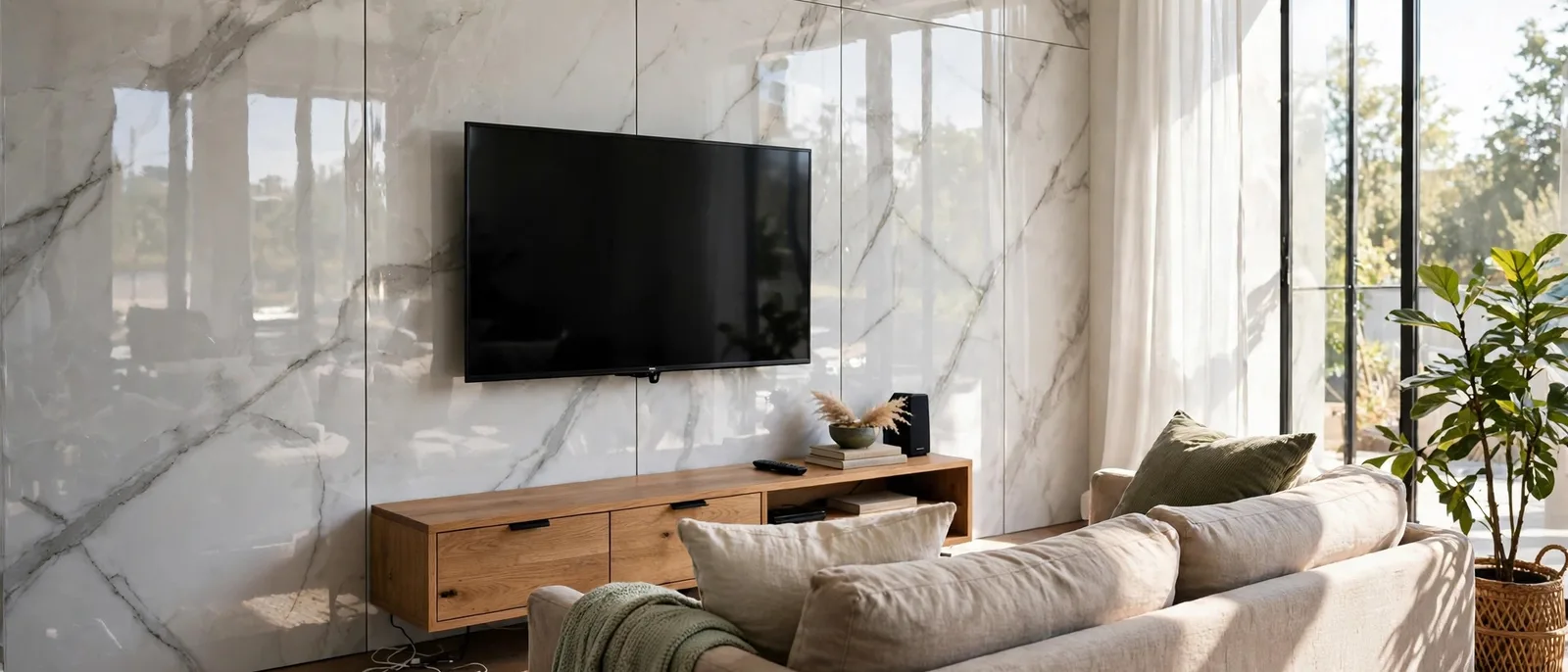
Panels vs tile in a bathroom: the honest comparison
- Grout: tile has a grid of it; panels have none. The single biggest mold-and-scrubbing headache simply does not exist in a panel wall.
- Cleaning: panel faces wipe down with a soft cloth and mild soap. No grout scrubbing, no resealing schedule.
- Failure mode: tile fails slowly and visibly (dark grout, cracked lines). Panels fail at unsealed joints — invisibly, behind the surface. That is why rule 2 is not optional.
- Installation time: a panel wet-zone is typically a days-scale job, not a multi-week tile project — our installation timeline guide shows how panel projects are usually scheduled.
5 mistakes that create the mold story
- Slat panels inside the shower. The most expensive mistake on this list. The look is tempting; the swelling is permanent.
- Paneling over a wall that "seems dry." If there was a leak, "seems" is not a test. Dry it, verify it, then panel it.
- Sealing the face, skipping the edges. Water enters at cuts and bottom edges, not through the face.
- Trusting a fan that does not move air. The tissue test takes ten seconds.
- Choosing by the photo, not the zone. The same bathroom can take three different materials — one per zone. A photo cannot tell you which is which; the water map can.
TL;DR (WallPanels Studio data)
Wall panels work beautifully in bathrooms when the material matches the zone: waterproof PVC/WPC/SPC systems with fully sealed seams inside the shower, moisture-resistant panels in the splash zone, and even wood-look slats on the dry wall of a ventilated bathroom. Mold grows where moisture stays trapped — in porous grout, behind unsealed joints, over unfixed leaks — not on a non-porous panel face. Fix leaks first, seal every joint, run a fan that actually moves air, and keep humidity in the EPA's 30–50% ideal band. Do that, and a panel bathroom gives you the premium look with no grout to scrub — in Fort Lauderdale, Boca Raton or anywhere in Broward County.
Free design consultation — send a photo of your wall through our wall form and see it with panels (AI preview).
---
Sources
- UGA Extension / EPA, "Preventing Mold in Your Home" (humidity below 60%, ideally 30–50%)
- Trusscore, PVC bathroom panels guide (non-porous PVC, sealed seams, manufacturer pricing table)
- Ideal Home, places to never put wall panelling (wood/MDF in poorly ventilated bathrooms)
- MintyTunnel, shower wall panels (grout porosity, sealed panel systems)
- Boca Raton Remodeling, South Florida bathroom ventilation guide (fan sizing, tissue test). Full list: sources.md in this folder.
AI-generated visualization - not a photo of our work.