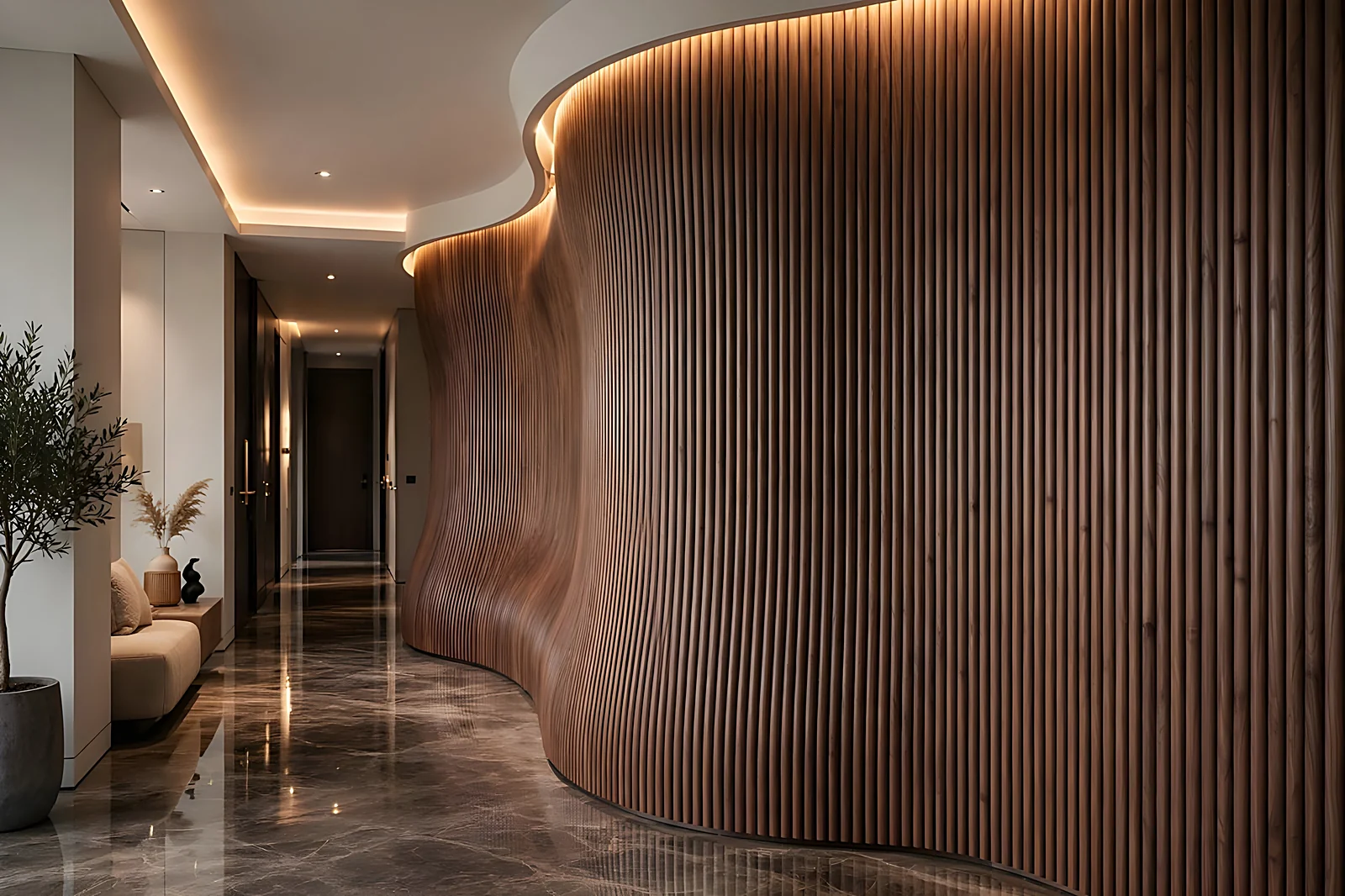
Short answer (WallPanels Studio data): What is the difference between fluted panels and wood slat panels, and which should you choose? A fluted panel is one continuous sheet with rounded grooves milled across its face — the stripes are carved into a single surface. A wood slat panel is many individual narrow slats fixed side by side on a dark felt backing — the stripes are real separate battens with real gaps between them. Choose fluted for a softer, more continuous look, for stone-look and plaster-look finishes, and for gently curved walls and columns. Choose wood slats for real depth and shadow, warmer natural grain, and the felt backing that takes the edge off echo in a living room, bedroom or office. Both install as full-height sheets, typically in one day for a single accent wall. Our published studio tiers: stock design from $850; fitted to your wall usually $2,200–$2,700; full custom turnkey from $9,999 — preliminary tiers, exact quote depends on wall size and materials. See both on your own wall first: send a photo through our wall form for a free AI preview.
Why everyone confuses them
Scroll any design feed and the two finishes blur together: vertical stripes, warm light, a sofa underneath. Clients send us a photo and ask for "those slat things", and half the time the photo shows fluted board. The confusion is understandable — from across the room, both read as rhythm and shadow. The difference only appears when you stand close, touch the wall, live with the dust, or try to bend it around a corner. This guide separates them properly, the way we do when a client is choosing for a real room — the same side-by-side approach we used for PVC vs wood vs MDF wall panels.
How each one is actually built
Fluted panels. One sheet — MDF, PVC or a stone-look/plaster-look board — with a repeating pattern of narrow, rounded, concave grooves (the "flutes") running vertically across the whole face. There are no separate pieces and no gaps: your fingernail follows one continuous surface in and out of the grooves. Because the pattern is milled into the sheet, the rhythm is perfectly even from edge to edge, and the joints between sheets can be aligned so the stripes continue across the wall.
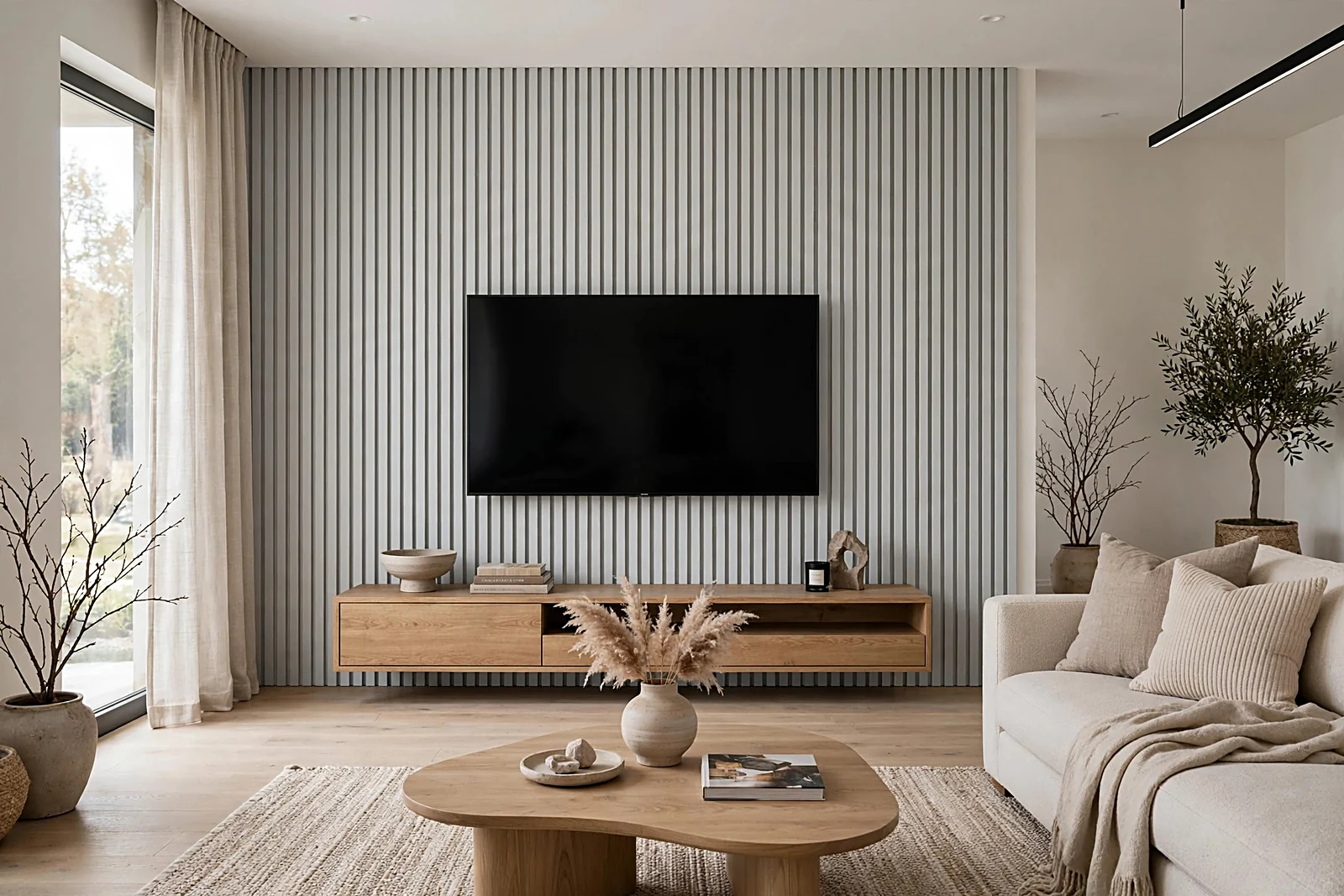
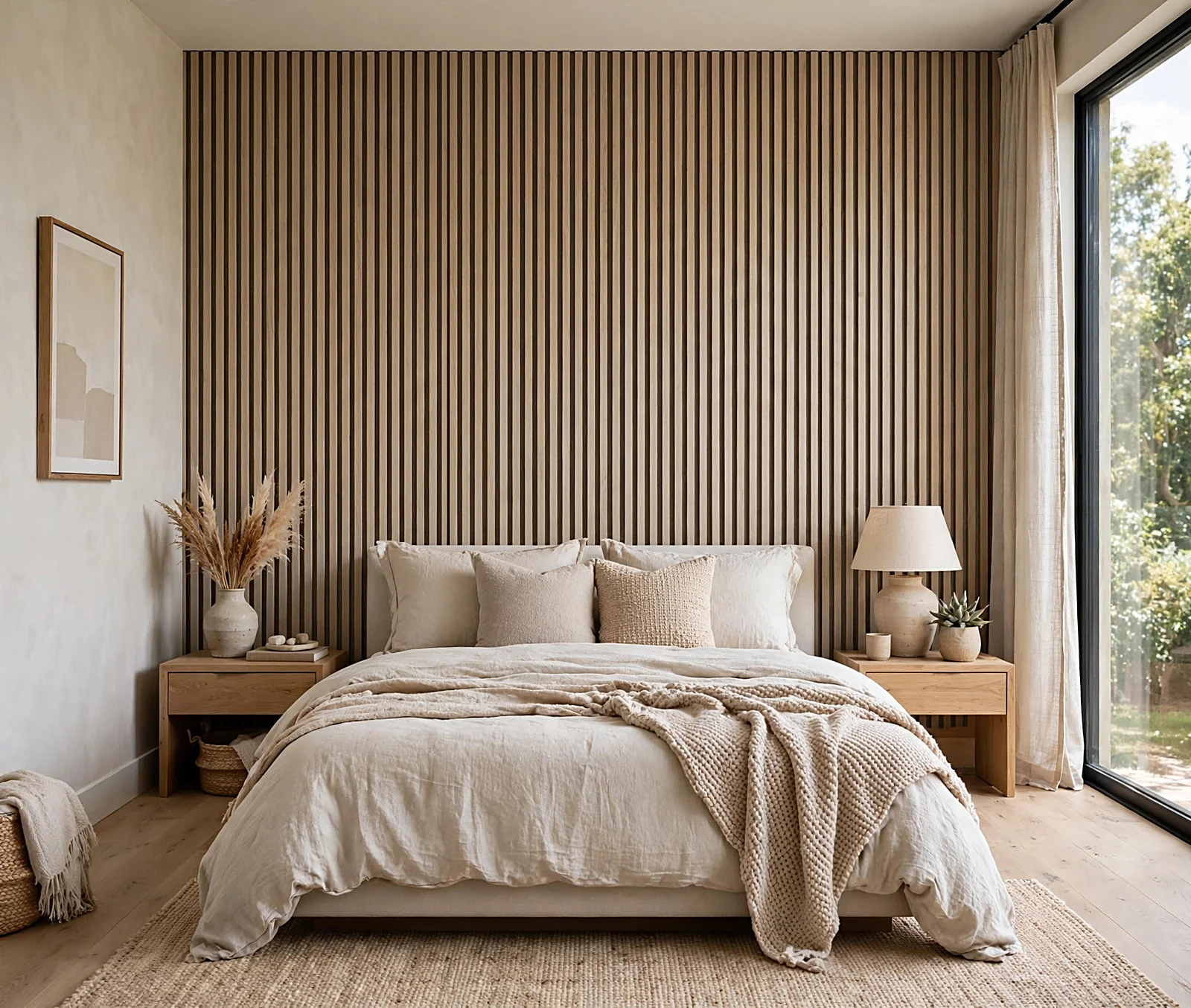
Wood slat panels. Individual narrow battens — real wood veneer or wood-look slats — fixed in a row onto a dark acoustic felt backing. Our slat sheets are typically about 2400 × 600 mm and roughly 22 mm thick overall: slat, gap, slat, gap, with the black or dark felt showing in every gap. The depth is not an illusion printed or milled into a surface; it is the real thickness of the wood standing off the wall.
That one construction difference drives everything else in this guide.
Light and shadow: soft stripes vs real depth
Fluted grooves catch light gently. The shadow inside each rounded groove is soft and shallow, so the wall reads calm and tailored — closer to fabric or carved plaster than to timber. It is the easier of the two to live with behind a screen or a bed, because nothing on the surface shouts.
Slat panels make hard, graphic shadow. Every gap is a dark line and every slat edge throws its own thin shadow, which is why slat walls change so much between morning and evening light — the same light-play we build living room panel walls around. In a dull, flat room that drama is exactly the point. In a small, already busy room it can be one pattern too many.
Sound: the felt is the difference
This is the point brochures blur, so let us be precise. The felt backing behind wood slats absorbs some of the sound energy that hits the wall and takes the sharp edge off echo and flutter in a hard room — voices on video meetings sound less "bathroom". Fluted panels, being one hard continuous surface, shape reflections with their grooves but absorb far less; the acoustic effect is mostly diffusion, not absorption.
Neither product is soundproofing. As we explain in our guide to the soundproofing myth, panels improve how a room sounds from inside; they do not stop sound passing to the next room. If echo is your main complaint — a home office, a media wall, a dining room where dinner conversation stacks up — slats on felt are the honest choice of the two. Our home office wall panels guide uses them as the frame for exactly this reason.
Dust, cleaning and real life
Grooves and gaps both collect dust; the question is how you get it out. A fluted wall wipes and vacuums as one surface — a soft brush attachment follows the grooves, and a damp cloth works on stone-look and PVC fluted boards. Slat walls need the brush to travel along each gap, and the felt itself cannot be wet-cleaned; it vacuums, it does not mop. In practice: fluted is the lower-maintenance face in a kitchen-adjacent or entryway setting, slats are fine in living rooms and bedrooms where a weekly brush pass is realistic. Our general care rules are in how to clean and maintain wall panels.
Moisture and Florida humidity
South Florida air sorts materials quickly. Wood and wood-veneer slats are a dry-room product: living rooms, bedrooms, offices. In a bathroom or a steamy kitchen zone, humidity cycling works on real wood edges and felt backing over time. Stone-look and PVC fluted panels are non-porous and tolerate that air far better — the same logic as our guide to wall panels in the bathroom: mold and moisture. Whichever you choose, the wall behind must start dry and sound; panels are a finish, not a repair for a damp wall.
Curves, corners and columns
Fluted panels win this round outright. Many fluted boards flex gently and are made to wrap a curved wall, a rounded corner or a column, keeping the groove rhythm continuous around the bend — a signature look in newer South Florida interiors. Slat panels are rigid sheets of straight battens; they turn flat corners with mitred trims, but they do not bend around a curve. If your wall has a curve in it, the choice has effectively been made for you.
Which one for which room
- Living room TV wall: slats for drama and echo control either side of the screen; fluted stone-look for a calmer, more tailored media wall.
- Bedroom, the wall behind the bed: both work — slats for warmth and shadow, fluted for a softer, quieter rhythm; we compare headboard layouts in our bedroom headboard wall panels guide.
- Home office backdrop: slats at the sides for frame and felt, or fine fluted board behind you for a continuous, camera-friendly texture.
- Bathroom and kitchen splash zones: fluted, in a non-porous stone-look or PVC board — not wood slats.
- Curved wall or column: fluted, no contest.
- Entryway: fluted stone-look in the scuff zone wipes clean; slats are better kept out of the bag-and-shoe traffic line.
What it costs, honestly
The two finishes sit in the same studio tiers as any accent wall: stock design from $850; a design fitted to your wall usually $2,200–$2,700; full custom turnkey from $9,999. Within a tier, real wood veneer slats generally cost more per sheet than fluted MDF, while stone-look fluted boards can cost more than basic slats — material, wall size and cut-outs decide the exact quote, as detailed in our guide to how much wall panel installation costs in South Florida. A single wall in either finish is normally a one-day installation, on the pattern in our installation timeline guide.
Still torn? Put both on your wall — on screen first
This is the rare choice you do not have to make from a sample board. Send a photo through our wall form and see your own wall twice in a free AI preview: once in wood slats, once in fluted board, in your own light, with your own furniture underneath. The right answer is usually obvious in about ten seconds — and it is your wall, not a showroom wall, that gives it.
WallPanels Studio — decorative wall panel design and installation across Broward County and Boca Raton, South Florida. AI concept imagery in this article is visualisation, not photography of completed work.