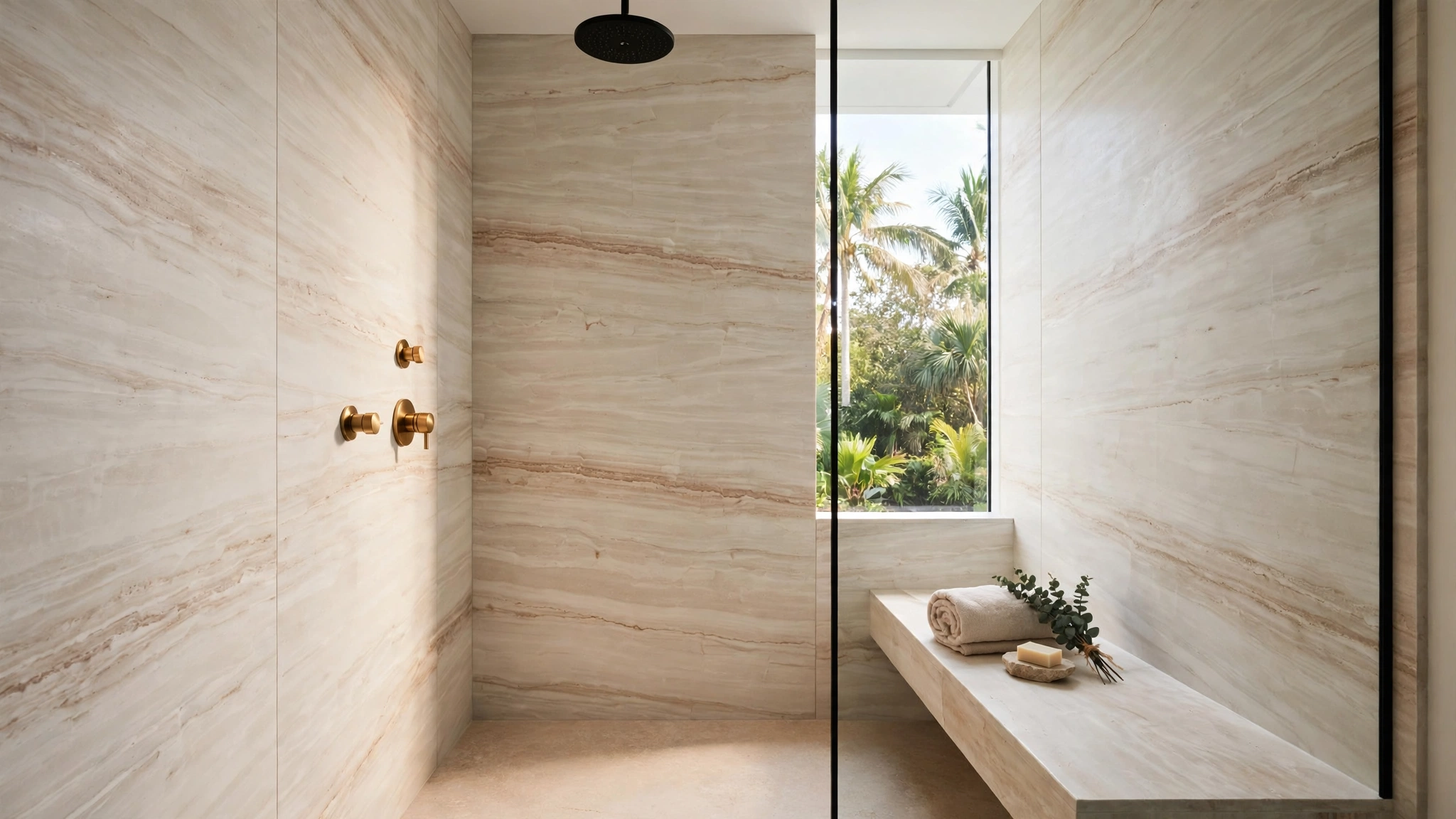
Short answer (WallPanels Studio data): Yes — the right wall panels can go inside the shower itself, not just on the dry walls around it, and they remove grout from the wettest room in the house. But "waterproof" is a system, not a sheet: the panel face does not absorb water, yet the shower stays dry only when every seam, corner and fixture cut-out is sealed and the wall behind was sound and properly prepared. Large-format stone-look panels — for example CNT-09 Continuous Pattern on the back wall with GST-04 Glossy Stone at the sides — cover a shower wall in a handful of pieces instead of hundreds of tiles and grout lines, wipe clean in seconds, and a single shower usually installs in one day. Tile still wins for intricate patterns and for repairing one small damaged area. Our published studio tiers: stock design from $850; fitted to your wall usually $2,200–$2,700; full custom turnkey from $9,999 — preliminary tiers; the exact quote depends on shower size, materials and the state of the existing walls. See it on your own shower first: send a photo through our wall form for a free AI preview.
The problem is never the tile. It is the grout
Ask anyone in South Florida what ages first in their shower and the answer is never the tile — it is the grey-beige web between the tiles. Grout is porous by nature. It drinks soapy water, it darkens, and in Florida humidity it is the first place mould finds a home. A tiled shower can have hundreds of grout lines; every line is a maintenance appointment you did not know you booked.
That is exactly why "waterproof shower wall panels" and "shower panels vs tiles" have become such common searches. The idea is simple: replace hundreds of small pieces and their joints with a few large, non-porous sheets whose only joints are sealed seams. Fewer joints, fewer places for water and grime to sit — that is the whole promise, and it is a real one. The rest of this article is about the conditions that make the promise hold.
What "waterproof" actually means inside a shower
A panel face made for wet zones does not absorb water — it will not swell, soften or rot the way a painted drywall wall or a wood product would. That part is straightforward. The honest part is everything around the face:
- Seams are the waterproofing. Where two panels meet, at internal corners, and where the panels meet the shower tray or tub, the joint is closed with sanitary silicone. An unsealed seam behind a waterproof face is a hidden leak with a beautiful cover.
- Fixture cut-outs get sealed too. Every hole for a shower head, mixer or grab bar is a penetration, and each one is sealed — no exceptions.
- The wall behind still matters. Panels are not a cure for a wall that is already wet, soft or mouldy behind old tile. At the check stage we look for exactly that: if the substrate is damaged, it is repaired first. Our guide to wall panels in the bathroom and moisture covers what we find behind Florida bathroom walls — and our article on installing panels over existing tile explains when the old tile can stay and when it cannot.
- Not every panel belongs in a shower. Decorative panels for dry walls — textile, padded, wood-look for a bedroom — are not shower panels. Inside the enclosure we use only wet-zone stone-look and continuous-pattern panels rated for direct water.
Panels vs tile, side by side and honestly
- Cleaning. Panels: one smooth surface, a soft cloth, done — there is no grout to scrub or re-seal. Tile: the faces clean easily, the grout lines are a recurring chore, and Florida's hard water and humidity shorten the interval.
- Installation time. A panel shower is usually a one-day install once the design is fixed — large sheets, no grouting stage, no cure time before the shower is usable. A comparable tiled shower typically runs several days with grouting and curing built in. Our installation timeline guide breaks down where the days go.
- Design freedom. Tile still wins here: tiny mosaics, herringbone, hand-made variation — panels cannot and should not imitate all of it. Panels win on the calm, large-stone look: one continuous veining across the wall instead of a grid.
- Repairs. A cracked tile can be swapped individually. A damaged panel means replacing that sheet — rarer, but a bigger single job. We say this plainly because it is the trade most panel marketing hides.
- Lifespan. Both last well over a decade when installed correctly; the panel system's weak points are its seals, the tile system's weak point is its grout — which is why the maintenance gap widens every year.
The full side-by-side also lives in our earlier comparison, wall panels vs tile for kitchen and bathroom; this article is the shower-specific version.
The mixes that work in a real shower
- Continuous stone on the back wall. CNT-09 Continuous Pattern runs the pattern across the wall with minimal visual breaks — the wall the shower head hangs on, and the one you face every morning.
- Glossy stone at the sides. GST-04 Glossy Stone catches light and water together; the gloss face sheets water off and brightens a shower that has no window, which describes most Florida condo showers.
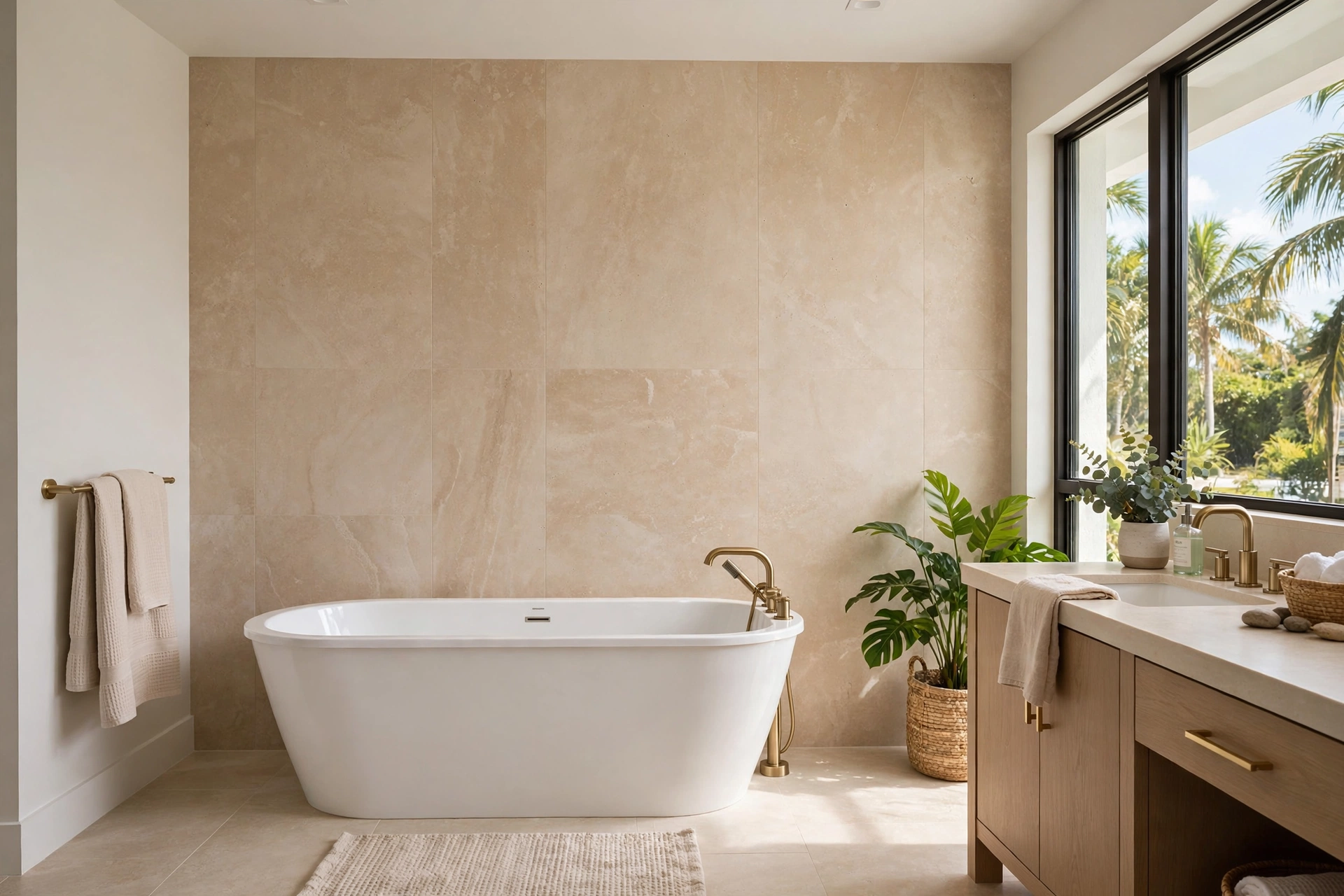
- Travertine calm for the whole enclosure. A warm travertine look (TRA-04 Travertine Marble family) on all three walls is the spa version — quiet, warm, and very forgiving of water spots between cleans.
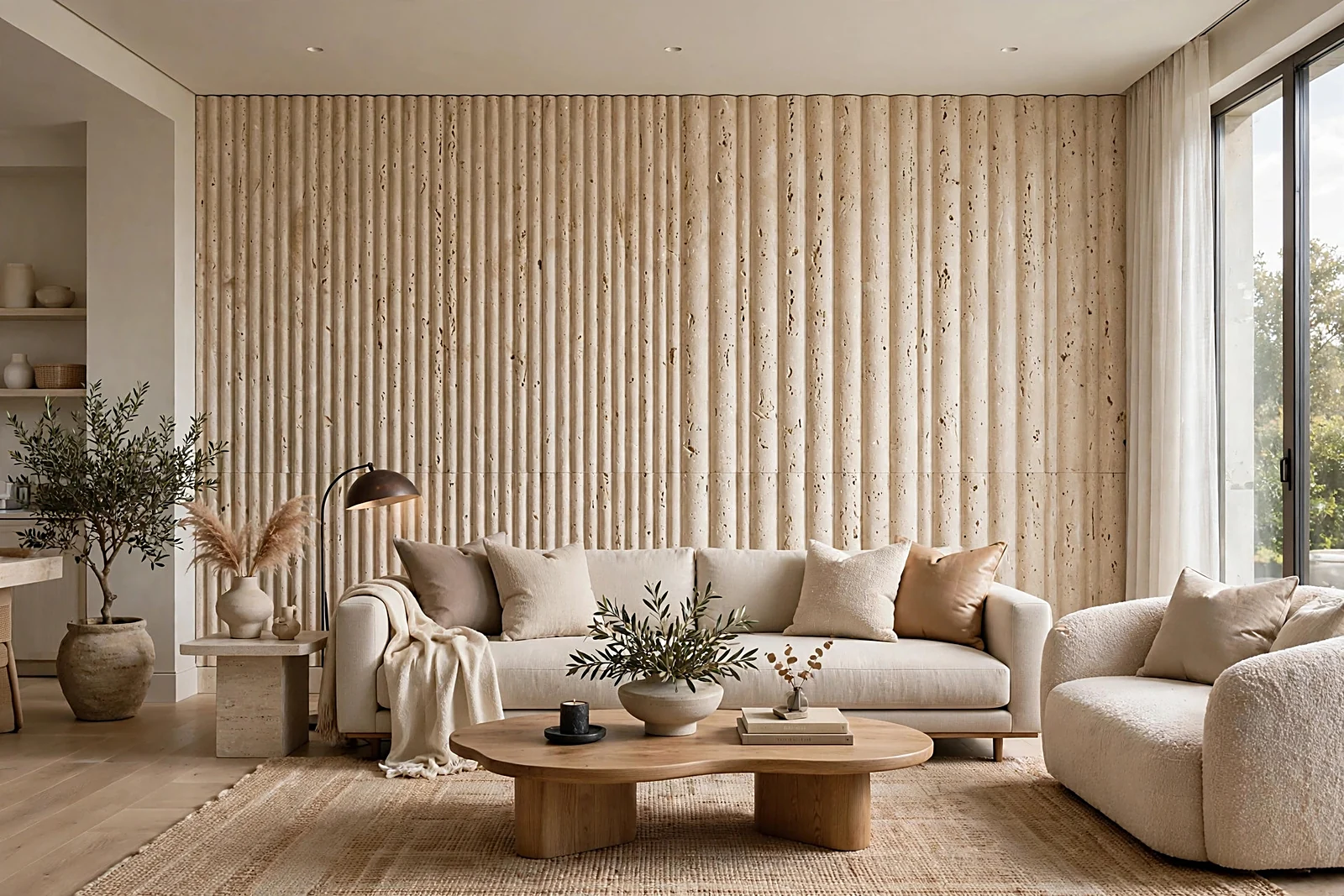
- What we would not do: wood or slat panels inside the enclosure (they belong on the dry bathroom wall outside it, where our bathroom humidity guide shows they work well), busy small patterns that fight the fixtures, or any panel whose wet-zone rating we cannot confirm.
The Florida footnote
Two local facts shape every shower we design. First, humidity never really leaves: ventilation in many Broward and Boca Raton bathrooms is a small fan and optimism, so surfaces that give mould nowhere to live earn their keep daily. Second, much of South Florida showers daily in hard water — mineral spots show fastest on dark grout and dark matte faces, which is why mid-tone stone looks are the practical luxury choice here. Homes from Hallandale Beach and Hollywood through Fort Lauderdale to Boca Raton share both facts.
What it costs, honestly
A shower enclosure is a compact project with one variable that matters more than size: the state of what is already there. The studio's published tiers frame it: stock design from $850; a design fitted to your wall usually $2,200–$2,700; full custom turnkey from $9,999. A straightforward panel-over-sound-tile shower sits at the lower end; a shower that needs damaged substrate repaired first is quoted with that work named openly. The full breakdown lives in our guide to how much wall panel installation costs in South Florida. Most single showers install in one day once the design is fixed and the wall check is done.
See your shower before you decide
Send a photo of your shower through our wall form and see that exact shower wearing panels in a free AI preview — continuous stone, glossy sides, or full travertine calm. If your existing walls hide damage the preview cannot see, we will tell you at the check visit before any panel is ordered, not after.
WallPanels Studio — decorative wall panel design and installation across Broward County and Boca Raton, South Florida. AI concept imagery in this article is visualisation, not photography of completed work.